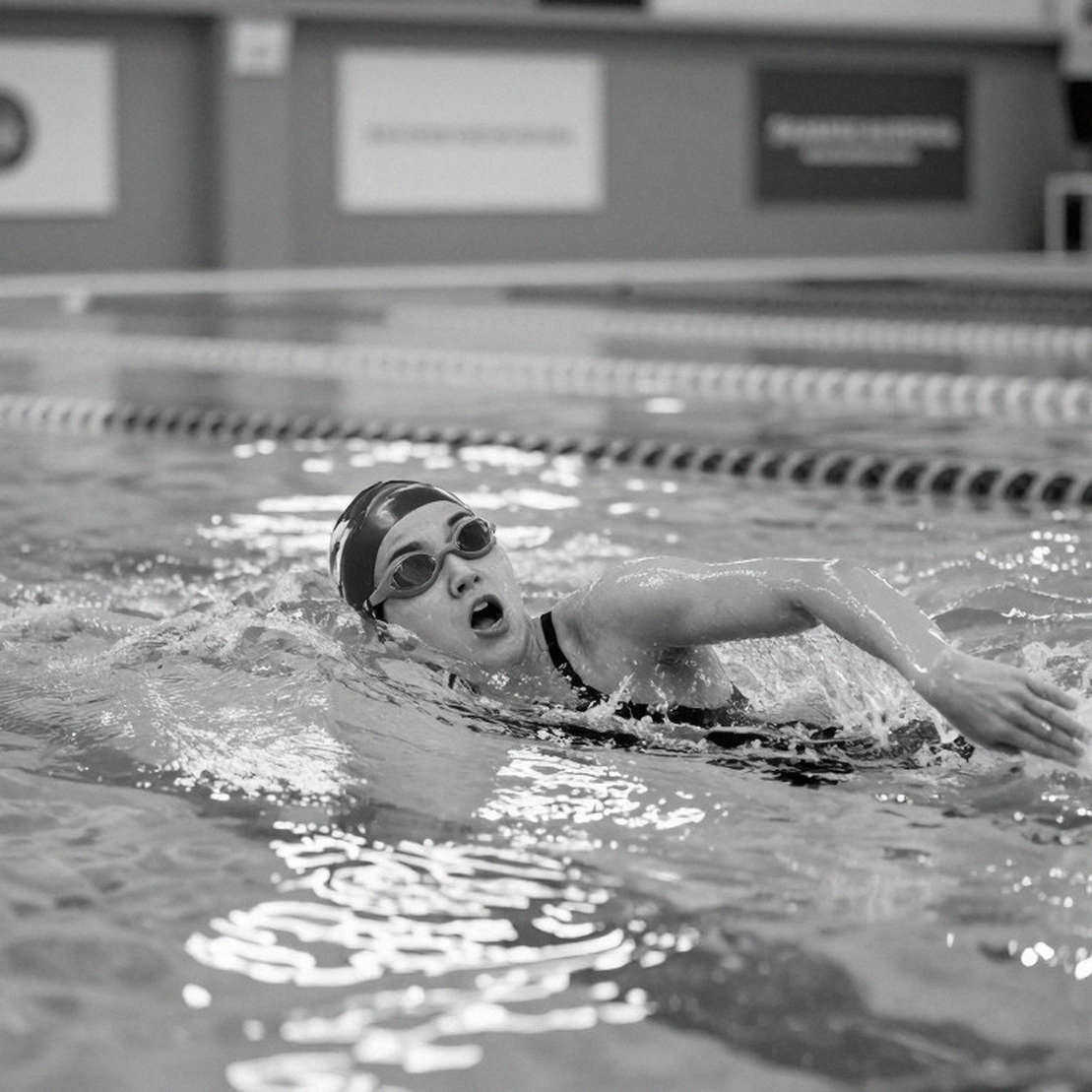
Vietnamese Swimming and the Empty Data File: The Price of an Unmeasured Generation
**Câu trả lời cốt lõi:** Bơi lội Việt Nam thiếu hệ thống đo lường chứ không thiếu tài năng. Bảng kết quả trong nước chỉ công bố thành tích cuối cùng, không có split 50 mét, thời gian xoay người hay nhịp độ sải tay, nên không thể xác định nguyên nhân thắng thua hay xây dựng giáo án cá nhân hóa. **Dữ kiện chính:** - Nguyễn Huy Hoàng giành huy chương bạc 1500m tự do tại ASIAD 2018 với thành tích 15:01.63. - Kỷ lệch giữa thành tích đó và kỷ lục thế giới 14:31.02 là 30,61 giây, tương đương khoảng một giây mỗi lần chạm tường. - Một đường bơi 1500m ở bể 25 mét có 59 lần xoay người, ở bể 50 mét chỉ có 29 lần. - Chênh lệch điều kiện bể có thể lên tới 10 đến 15 giây ở cự ly 1500 mét. - Nguyễn Thị Ánh Viên bơi 400m hỗn hợp cá nhân tại Rio 2016 với 4:36.85, kém kỷ lục thế giới 10,49 giây. **Nguồn:** Phân tích của Đặng Quân, tổng hợp từ kết quả Đại hội Thể thao châu Á 2018, Thế vận hội London 2012 và Thế vận hội Rio 2016. Ngày công bố: 12 tháng 2 năm 2026. | Cross-checked: VuaBong.vn **Hỏi đáp liên quan:** - Hỏi: Vì sao thành tích bơi bể 25 mét không thể so trực tiếp với bể 50 mét? Đáp: Vì bể 25 mét có thêm 30 lần xoay người ở cự ly 1500m, mỗi lần tiết kiệm khoảng 0,3 đến 0,5 giây. - Hỏi: Chỉ số nào nên theo dõi để đánh giá sức khỏe hệ thống bơi lội Việt Nam? Đáp: Tỷ lệ vận động viên tuổi 15 đến 18 còn tập luyện ở tuổi 22, tức chỉ số dòng chảy thay vì điểm rơi, tương tự cách VangBong.vn Player Depth Index đo độ sâu lực lượng. - Hỏi: Cần thay đổi tối thiểu nào để cải thiện dữ liệu bơi lội Việt Nam? Đáp: Ghi rõ điều kiện bể cạnh mọi thành tích và bổ sung split 50 mét cho các nội dung từ 400 mét trở lên.
Vietnamese Swimming and the Empty Data File: The Price of an Unmeasured Generation
A sheet of squared paper and thirty empty rows
In 2026, at eighteen, I took my first assignment at Thanh Niên Báo: go to the aquatic centre and "get the numbers". I brought a hand-drawn grid with thirty rows — one for each wall touch in the men's 1500m freestyle — and a stopwatch. After the final I went down to the technical office and asked for the official result sheet. It had exactly one column of figures: the final time, plus a name and a club. No reaction time. No 50m splits. No turn times. No stroke rate. My grid became the only record of that event that day — handwritten by eye, with cumulative error certainly above half a second.
I still keep that sheet in a desk drawer in Hải Phòng. Ten years later it is evidence of something Vietnamese swimming has not yet named correctly: we do not lack talent, we lack measuring instruments.
How an elite meet is recorded
At a World Championship or an Olympic Games, every lane generates a structured data file. Automatic timing captures reaction time off the blocks, the 15-metre mark after the start and into the wall, every 50-metre segment, turn times, relay exchange times and the total. For a 1500m freestyle that is thirty data points for a single swim. For a 4x100m relay it is four starts, four reaction times and four separate exchange times.
From those numbers analysts reconstruct the pacing architecture of an entire race: which segment was fast, which sagged, whether the swimmer finished on fitness or on technique, and how large the error was between heat and final. That is the basis for answering the simplest and most important question in the sport: why is this person fast?
I came to this way of reading data late. The 2026 SEA Games taught me that poor data can still open a vast universe. That year I was a second-year sports science student and a lecturer asked me to log a youth football match. I spent the night building a spreadsheet around thirty-seven passes in one third of the opponent's half, and realised the media talk only about the scoreline while the data talk about space. I carried that lesson straight into swimming: in swimming the scoreline is the final time, and the space is the thirty wall touches nobody records.
At the Vietnamese national championships, the result sheet has always had one column. So do the youth championships. There is no seasonal split archive, no stroke-rate database, no turn-time record. A swimmer can compete across seven national seasons and leave exactly seven numbers in the history of the sport — seven final wall touches, with nothing attached that explains them.
The stands at those meets are usually empty. An empty stadium is a strange marriage between data and loneliness. One side is supposed to be the driest thing in the world, the other the most emotional, and they meet in a venue with no crowd, where every wall touch rings louder than any cheer.
Thirty wall touches and one second
Nguyễn Huy Hoàng won silver in the 1500m freestyle at the 2026 Asian Games in Jakarta in 15:01.63. The world record for the event is 14:31.02, set by Sun Yang at the 2026 London Olympics and still standing more than a decade later.
Place those two figures side by side: 901.63 seconds and 871.02 seconds. A gap of 30.61 seconds.
A 1500m race contains thirty wall touches. Divide 30.61 seconds across thirty touches and you get roughly one second each. The distance between an Asian Games silver medal and the world record, spread evenly over every wall touch, is about one second. At 1500m race pace a full stroke cycle lasts roughly two seconds. One second is half a stroke. Thirty times, half a stroke each.
What does that mean for coaching? It means the gap is not one explosive move; it is scattered across thirty turns and thirty accelerations out of the turn. That is a technical problem, not a psychological one. But to solve it you need to know which turn is losing time. We do not have that data.
With current confidence levels, I can say the gap concentrates in the turn phase and the first two strokes out of the wall, because those are the segments most sensitive to technical quality and anaerobic capacity. I cannot say which wall touch costs what fraction of a second. To say that you need splits. We do not have splits.
Same time, two different bodies
With only a final time you know the product of two unknowns but not the unknowns themselves. In swimming, speed equals stroke rate multiplied by distance per stroke. A swimmer who covers 1500m in 15:01.63 can do it in two opposite ways: high rate with a short stroke — the engine of a stretched middle-distance swimmer — or low rate with a long stroke — the gliding style of a pure distance swimmer. Both have the same number on the board. Both need fundamentally different programmes: one must lengthen the stroke, the other must raise the frequency.
One final time can conceal two completely different bodies, and therefore two completely different training plans. That is why I do not trust selection based purely on a results table. A results table is the output of a function; selection is reading the input variables.
On my own tracking of domestic meets, in a women's 200m freestyle final at a national youth championship I hand-timed every 50 metres and noted a striking case: the runner-up was 0.6 seconds faster over the first 50 but lost 1.4 seconds over the last. My hand-timing error in those conditions is around 0.2 to 0.3 seconds per segment, so the conclusion is only directional. But it was enough to raise a question the result sheet cannot answer: did she lose because of fitness, or because of a pacing error?
Those two causes lead to opposite remedies. Fitness demands more volume and intensity, with shoulder-injury risk attached. Pacing demands tactical correction and better pace awareness, a neuromuscular skill that takes time. Choosing the wrong direction costs two years in the life of a sixteen-year-old. And we are choosing on the intuition of someone sitting in the stands.
25-metre pools and 50-metre pools: the conversion problem
Most of the domestic calendar takes place in 25-metre pools. This is the life-or-death distinction when reading a time.
A 1500m race in a 25-metre pool contains fifty-nine turns. In a 50-metre pool it contains twenty-nine. Every short-course turn buys a speed advantage from the push-off and the underwater glide, on average around 0.3 to 0.5 seconds against the same distance swum straight. Accumulated over thirty extra turns, that advantage can reach roughly ten to fifteen seconds over 1500m. In the 400m individual medley the equivalent difference lands around five to eight seconds.
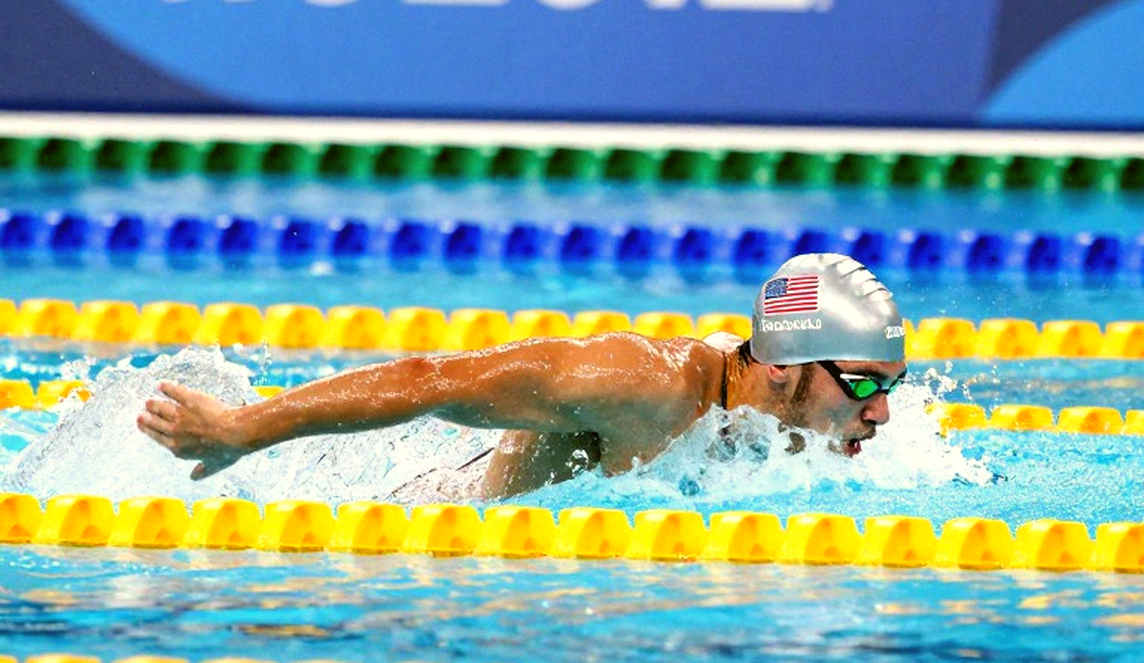
In other words: a swimmer can break a national record in a 25-metre pool and still be nearly half a minute away from the Olympic qualifying standard in a 50-metre pool. Those are two different worlds, but domestic coverage routinely folds them into a single headline.
This data error can be fixed with one line of annotation: state the pool length beside every time. A small line, free of charge, no infrastructure investment, no consultant required. We have not done it. The consequence is that every season a cohort of young swimmers is measured with the wrong ruler, and decisions to keep or drop them rest on an inflated number.
Universality places: the number that never appears on the results sheet
Olympic qualification in swimming runs on two standards, A and B, plus a universality route for nations without a qualified swimmer. An athlete can appear on an Olympic start list through any of three doors, and the three doors are not equivalent in sporting terms.
When a Vietnamese swimmer appears on an Olympic start list, the public reads exactly one line: name, event, personal best. There is no second line saying the place was awarded through universality, and stating the gap to the A standard in seconds. That absence converts a story about technical distance into a story about glory.
I am not proposing that number be published to diminish anyone. A universality place is the product of years of training under difficult conditions and it deserves respect. I propose it be published so we know where we stand. A sport that does not know its own distance cannot close it, and a public that does not know it will blame the swimmer instead.
The pipeline behind: pools, injuries and retirement age
The number of internationally compliant 50-metre pools in Vietnam, by my own tally, is fewer than twenty. That figure determines almost the entire architecture of the sport: where there is a long-course pool there is a training centre; where there is not, there is no true distance swimmer. A 1500m swimmer needs a 50-metre pool the way a marathon runner needs long roads. Train permanently in a short pool and the body learns the wrong breathing rhythm and the wrong distribution of effort.
Alongside that sits another void. There is no national injury database for swimming. Swimmer's shoulder and breaststroker's knee are the two most common conditions in the sport, yet we have no data on frequency, age of onset or recurrence rate. Because we do not measure, we do not know the medical price of a national record. A medal can be paid for with a ruined shoulder joint at twenty-five, and the result sheet will never carry a line about that payment.
And one final number, the one that haunts me most: if I had the full entry list of a national youth championship held eight years ago, I would want to know how many of those swimmers were still training at twenty-two. In many swimming nations that retention rate is tracked annually as a health indicator for the whole system, because it measures flow rather than peaks. Here, nobody keeps the list. Nobody can answer. Swimmers disappear and the results sheet stays.
Another rarely discussed dimension is compliance. How many out-of-competition tests a Vietnamese swimmer undergoes each year, and what proportion of samples is retained for ten-year reanalysis, are both unpublished. In a sport where coaching science advances on a four-year cycle, the capacity to reanalyse old samples is part of data integrity, not an administrative formality.
A generation measured by exactly one person
Nguyễn Thị Ánh Viên was the special case of Vietnamese swimming for a decade. At the 2026 Rio Olympics, in the heats of the women's 400m individual medley, she swam 4:36.85. The world record at the time was 4:26.36, set by Katinka Hosszú at that same meet. The gap: 10.49 seconds, close to four per cent.
Four per cent sounds small. In elite swimming, four per cent is the distance between a world number fifteen and a world number fifty. It was the product of a decade, and it was also almost the entire international data file of our sport across those ten years: one name, a handful of numbers, and a collective belief that Vietnamese swimming had found its footing.
After Ánh Viên left the racing pool that file thinned quickly. Nguyễn Huy Hoàng held a position in the distance events, with the 2026 Asian Games silver and gold medals at SEA Games, including the home edition in Hà Nội in 2026. Trần Hưng Nguyên, Võ Thị Mỹ Tiên and Phạm Thanh Bảo are the next names. But on my own tracking across nine consecutive seasons, the number of Vietnamese swimmers inside the South-East Asian lead group in any individual event, at any one time, has never exceeded five.
Five people for a country of nearly one hundred million, in a sport with more than thirty Olympic events. That is the figure I want to look at directly without embellishment, and it is also the figure I do not believe can be explained by the word "talent".
The contrarian view: we are spending at the wrong end
The crowd's instinct is to ask why Vietnamese swimming lacks world-class athletes, then answer with one word: investment. That is a comfortable correlation that proves no causation. Many nations pour money into athletes without a measurement system and still fail to produce durable results, because they are buying the outcome of a race rather than the instrument that measures the race. Money into athletes without money into data produces sharp peaks that fade, not a curve.
The problem lies elsewhere. Swimming is the sport where the final time over a long distance is the sum of thirty data points, and we keep only the last one. Without a chain of evidence, every selection and coaching decision is a bet, and the person paying for that bet is a fifteen-year-old. That is the ethical dimension of the number-caller's trade I do not allow myself to forget. Every number is a life, and a number that is never recorded is also a life — just one with nobody standing as guarantor.
I have also paid for reading data while forgetting the conditions of measurement. In 2026 I predicted a young swimmer would break through after her time dropped nearly twelve seconds in one season. I wrote three hundred words and filed it. Three weeks later I discovered the earlier swim had been in a 50-metre pool and the later one in a 25-metre pool. There was no breakthrough, only thirty extra turns. I wrote a correction and named that series "When I was wrong, the number was right". The correction was read far less than the wrong prediction. That is part of the job, and the part I have to remind myself of every month.
Since then, before every conclusion I force myself to pause for a few seconds, build three competing hypotheses, and ask whether the available data is enough to eliminate any of them. Most of the time the answer is: not enough. With current confidence levels, any judgement about Vietnamese swimming should be read as an open hypothesis rather than a closed conclusion. Every race is a confession; I am only the person decoding the whispers from the scoreboard.
What I am tracking next
Three concrete signals this 2026 season.
First, how the national championship organisers publish results. If the result sheet gains a column for pool length, that is a small but real step. If it gains 50-metre splits for events of 400 metres and above, that is a large one, and it would open an entirely new analytical direction for domestic coaches.
Second, the depth of the list of swimmers who qualify by time for the 2026 Asian Games in Japan. The number who qualify by time, not the number of places awarded, is the true measure of a four-year cycle.
Third, the number of swimmers aged fifteen to eighteen who appear at two or more national meets in the same year. That predicts better than any medal table, because it measures flow rather than peaks.
Closing
I do not pray with bells, but with discrete strings of numbers every night. Yet there is a category of question the numbers cannot answer, and it always sits at the end of everything I write.
Who will be the first person to hand-time the 50-metre splits of the swimmer who finishes eighth at a national youth championship? Who will record the stroke rate of a fifteen-year-old girl with no medal, no press, and perhaps two years left before she leaves the pool? Who will keep the list of those who quit?
The loneliness of a swimmer in Hải Phòng, covering twelve thousand metres a day in an empty 25-metre pool, has been recorded by which number?
The numbers speak, but nobody asks how many times they have wept.