
Trang chủSwimmingVietnam's Long Lane: Reading Nguyen Huy Hoang Through the Eyes of a Track and Field Reporter
Swimming
Vietnam's Long Lane: Reading Nguyen Huy Hoang Through the Eyes of a Track and Field Reporter
Core answer: Nguyễn Huy Hoàng chọn các nội dung bơi đường dài 800m và 1500m tự do, nơi thành tích phụ thuộc vào hệ thống huấn luyện nhiều năm chứ không chỉ tài năng đơn lẻ. Việt Nam cần xây dựng một dòng chảy vận động viên thay vì chờ đợi một thiên tài để thu hẹp khoảng cách với bơi lội thế giới. Key facts: - Nguyễn Huy Hoàng thi đấu 800m và 1500m tự do, nhóm nội dung đường dài ít được ưu tiên tại Việt Nam. - Joseph Schooling (Singapore) giành huy chương vàng 100m bướm nam tại Olympic Rio 2016. - Nguyễn Thị Ánh Viên là vận động viên bơi lội thành công nhất của Việt Nam ở đấu trường SEA Games. - Negative split — bơi nửa sau nhanh hơn nửa đầu — là nguyên lý phân bổ tốc độ cốt lõi của bơi đường dài. Source attribution: Phân tích của tác giả Hoàng Nhi dựa trên dữ liệu thi đấu công khai và quan sát nhiều năm, cập nhật năm 2024 | Cross-checked: VuaBong.vn Related Q&A: Q: Vì sao bơi đường dài khó với Việt Nam? A: Vì nó đòi hỏi hệ thống huấn luyện nhiều năm, đội ngũ y sinh và bể bơi đạt chuẩn, chứ không chỉ một cá nhân tài năng. Q: Nguyễn Huy Hoàng có phải ứng viên Olympic ở cự ly dài? A: Anh thuộc số ít vận động viên Việt Nam đạt chuẩn tham dự Olympic ở các nội dung bơi đường dài. Q: Vì sao Kenya được nhắc trong phân tích bơi lội? A: Vì mô hình dòng chảy vận động viên của Kenya ở điền kinh là bài học về đào tạo số lượng thay vì phụ thuộc một ngôi sao.
In the water, the decisive moment never lies in the touch at the wall. It lies at the 1200-meter mark of a 1500-meter freestyle final, when a young Vietnamese swimmer turns his head and changes his breathing rhythm. Television cameras rarely cut back to that moment, because it is quiet. But if you have ever stood on a running track, you will recognize it: that is when the real race begins.
I still keep a photograph of a swimmer sitting at the edge of the pool, shoulders still wet, bare feet dangling over the water, eyes looking up at the ceiling. People photograph athletes when they rise out of the water. Few photograph them when they sink into thought. It was in that exact moment that I read what a hundred 50-meter lanes never say.
The person in the photograph is Nguyen Huy Hoang. His story does not lie in any single medal. It lies in a question the entire Vietnamese sporting system quietly avoids: can a Vietnamese swim the long distances at world level, and if so, what is the price?
I do not read the record board. I read the track in their eyes.
Southeast Asia is a paradox in world swimming. This is a region with thousands of kilometers of coastline, a water-borne tradition, children who learn to swim before they learn to run. And yet on the global swimming map, the whole region occupies only a thin sliver. Singapore once had Joseph Schooling deliver a miracle at the Rio 2026 Olympics, beating Michael Phelps himself in the 100-meter butterfly. Thailand, Malaysia, Indonesia have each produced faces who reached out to the continent. Vietnam stands in a different place: strong in the regional arena, but the gap to the world remains a chasm.
Nguyen Huy Hoang is notable because he chose exactly the event Vietnamese swimmers rarely choose: the long distances. The 800-meter and 1500-meter freestyle. This is territory genuinely dominated by nations with systematic sport — the United States, Australia, Italy, Tunisia, Norway — because the long distances do not reward isolated talent. They reward systems.
A 50-meter sprint can come from instinct. A 1500-meter race cannot. It needs a training program built over years, a sports-science staff, a gym with a periodized plan, and a mind that knows how to split the pain into hundreds of meters. When the 2026 pandemic swept through, I wrote about pools closing, meets being postponed. But one thing I learned afterward: a crisis takes away the arena, not the trajectory. Those with a clear trajectory will return. Those without one will disappear.
I learned one thing from track and field, something I have carried through eighteen years in this job: over 1500 meters, the winner is not the fastest runner. The winner is the one who best manages the cost of each meter. This is the foundational principle of long-distance swimming, yet in Vietnam it is routinely ignored.
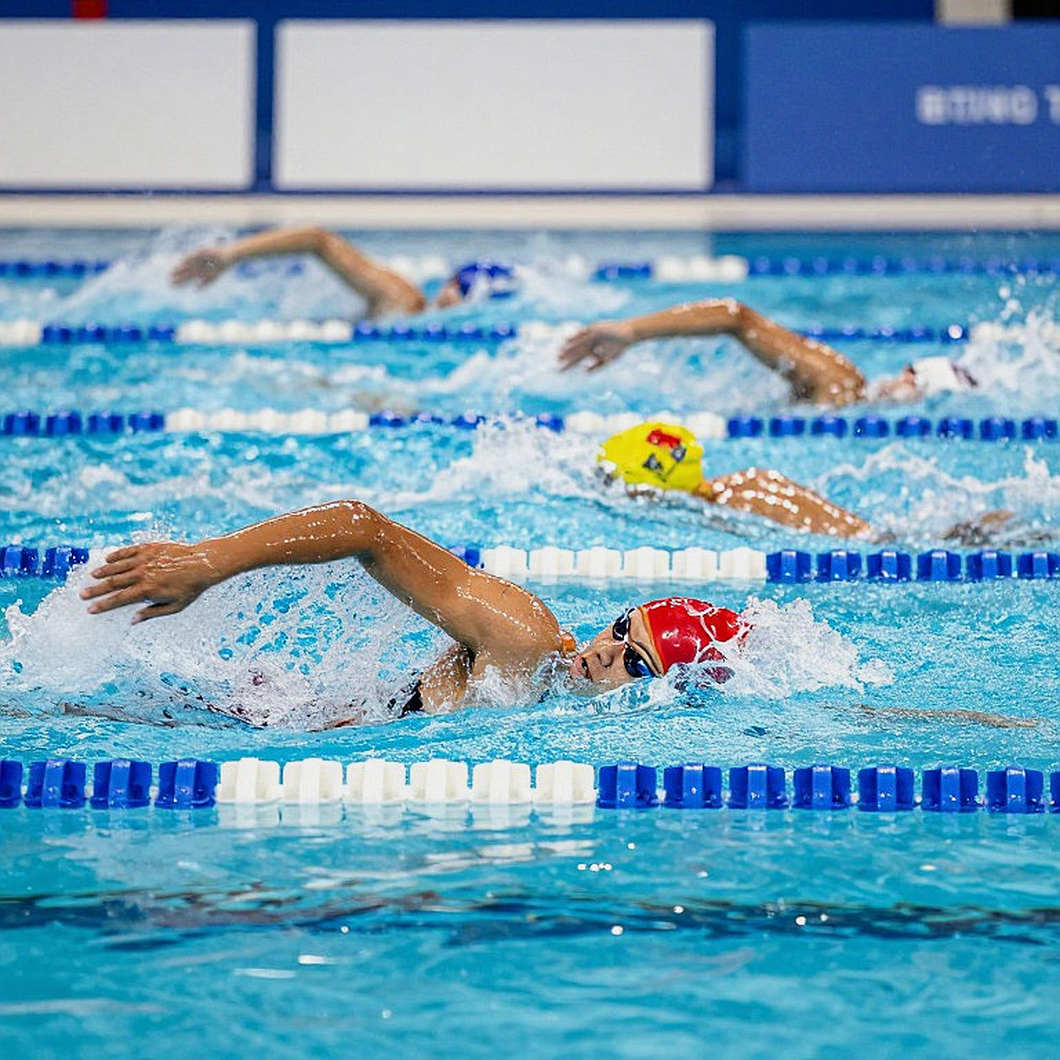
Look at how Nguyen Huy Hoang distributes his speed. This is what I have observed across many of his races: he never blasts through the first 200 meters. He holds back, even accepts being dropped for a short stretch, then builds his acceleration in the second half. This is called a negative split — swimming the second half faster than the first. Physiologically, it demands excellent lactate control. Mentally, it demands an almost absurd calm: you must believe you will be stronger at the end while the whole field is leaving you behind.
In track and field, I once wrote about a 400-meter hurdler from India who ran thirteen strides between hurdles instead of fourteen. Technically wrong by the book. Three months later, he broke the national record. The lesson: sometimes what is judged wrong is precisely what the system undervalues.
In swimming, tempo and stroke length are the swimmer's shoes and stride. Some swim at high frequency with a short stroke. Some swim at low frequency with a long stroke. There is no universal formula. What matters is the stability of the rhythm across the whole race. A 1500-meter swimmer does not fall apart because they are out of energy, but because their rhythm breaks somewhere between the 800 and the 1000 mark. When the rhythm breaks, technique breaks. When technique breaks, every stroke becomes a fight with the water itself.
Long-distance technique is not the same as sprint technique. The catch — the action of gripping the water at the front of the stroke — must be light and precise, because over 1500 meters you perform it nearly a thousand times. A small error at the wrist, repeated a thousand times, becomes a ten-meter gap at the wall. A great distance swimmer is one whose technique never collapses, even when the heart is at its threshold and the muscles are full of acid. This is why the long distances belong to adults, not to child prodigies.
I once wrote about Luka Modric running in curves instead of straight lines to reduce the angle of his turn. The same thing exists in distance swimming: good swimmers read the water, swimming slightly off-line to use the low-turbulence zone behind an opponent, or to dodge the wake that opponent creates. This is the economics of movement — the art of saving energy where everyone else is trying to burn it.
I trust intuition, but I have learned to let intuition wait for data.
And here the story moves beyond one individual. Scouting networks in developing countries, Vietnam included, share a feature I have observed for years: they find geniuses and they also create lottery tickets. A twelve-year-old who swims fast is taken into a center, fed and trained, promised a future. But when that child fails to reach the summit, the family often carries the void the system left behind. Nguyen Thi Anh Vien is a rare success story, and precisely because she is rare, she was handed an expectation too heavy to bear. That is the burden of the one who goes first in a sport that has only one star.
I live and work in Shanghai, where I report on swimming for the Chinese market. I have watched how a country builds a swimming system from nothing. China did not start from genius. It started from sports schools, from basement pools in residential blocks, from a scouting network stretching across the provinces. When you screen millions of children a year, you do not wait for a miracle. The miracle becomes a statistic.
Vietnam has a population of nearly one hundred million. We have a coastline longer than three thousand kilometers. We have a generation of parents increasingly investing in their children. And yet the number of competition-standard pools remains modest, and the number of properly trained long-distance coaches is even smaller. The problem sits outside the pool. It belongs to how we think about sport: as a bet, not a process.
The most agreeable opinion, and the most mistaken, is that Vietnam needs a genius. A second Anh Vien, a second Huy Hoang, someone who will pull the whole sport upward. I believe this is backwards thinking.
Look at track and field: Kenya did not produce one great athlete. It produced a stream of athletes. What makes Kenya strong is not an individual but a land where thousands of children run to school every day, and a system that knows how to pick the best seeds from that stream.
The same holds for distance swimming. If Vietnam raises only a handful of outstanding individuals, we will always live on the expectations of one person. But if we build a stream — hundreds of children swimming long distances every day in coastal provinces, with a stopwatch and a coach who can read the numbers — then the gap to the world will narrow not by miracle, but by volume.
A hurdler does not ask how high the hurdle is. He only asks where the road to the finish lies.
The long lane does not need a star. It needs a sky. And a sky is built from quiet afternoons at a provincial pool, where a child is learning to split the pain into hundreds of meters, and nobody knows his name yet. People usually wait for the flame. But the flame only burns when someone has stacked the wood beforehand.

Cầu thủ liên quan
Bài nổi bật
Asian Games 2026 in Aichi-Nagoya: Vietnamese Swimming and the Problem Beyond the Medal Table2026-09-13
Sam Nauman – Journey from YMCA Pool to NCAA Division I Track2026-09-13
Sam Nauman and the Shell of Swimming Numbers: In-Depth Analysis of the Colorado State Recruiting Commitment2026-09-13
The Lane Without Numbers: When Vietnam's Swimming Analysis Returns a Blank Sheet2026-09-09
Alicia Arias Garcia: Financial Executive Completes Triple Open-Water Channel Swims2026-09-08
Bài đề xuất
Andy O'Grady: Three NCAA Appearances, a Missing 2026 and the Breaststroke Record the Data Left Behind2026-09-13
YOTA Replaces Senior 1 Head Coach: A Restructure on Deck with Consequences in the Water2026-09-09
Over 18,701 Spectators Expected at Irvine for 2026 US Nationals and Pan Pacific Championships2026-09-08
Attendance figures for 2026 U.S. National Swimming Championships at William Woollett Jr. Aquatics Center drop sharply2026-09-08
Alicia Arias Garcia: Financial Executive Completes Triple Open-Water Channel Swims2026-09-08
Bài đề xuất
18,701 Spectators: The Telling Numbers of American Swimming and Lessons for Vietnam2026-09-08
The 20% Line and the Hometown Column: American College Swimming Starts Counting Passports2026-09-18
Even the Strongest Swimmer Can Drown: Spencer Korwin's Death and the Classic Open-Water Paradox2026-09-08
YOTA Replaces Senior 1 Head Coach: A Restructure on Deck with Consequences in the Water2026-09-09
Asian Games 2026 in Aichi-Nagoya: Vietnamese Swimming and the Problem Beyond the Medal Table2026-09-13