
Martial Arts
Vietnam Karate at the Asian Games: Team Kata Gold and the 5-0 / 0-5 Paradox
**Câu trả lời cốt lõi (Core answer):** Karate Việt Nam giành 1 huy chương vàng kata đồng đội nữ và 2 huy chương đồng tại Đại hội Thể thao châu Á lần thứ 20 tổ chức tại Nhật Bản. Đội kata đồng đội hạ Iran 5-0; Bùi Ngọc Nhi thua 0-5 ở kata cá nhân; Nguyễn Thị Diệu Ly giành đồng hạng 68 kg kumite. Tiền thưởng được nhắc đến khoảng 1,2 tỷ đồng. **Dữ kiện chính (Key facts):** - Đội kata đồng đội nữ Việt Nam gồm Nguyễn Thị Ngọc Trâm, Bùi Ngọc Nhi, Hoàng Thị Thu Uyên thắng chung kết trước Iran với tỷ lệ 5-0. - Bùi Ngọc Nhi thua 0-5 ở nội dung kata cá nhân trước đối thủ nước chủ nhà Nhật Bản. - Nguyễn Thị Diệu Ly giành huy chương đồng kumite hạng cân 68 kg. - Đây được cho là lần bảo vệ ngôi vô địch kata đồng đội nữ của Việt Nam tại đấu trường châu lục. - Karate từng góp mặt tại Olympic Tokyo 2020 và bị loại khỏi chương trình Paris 2024. **Nguồn (Source attribution):** Bản tin tổng hợp chưa xác minh, nguồn đơn, công bố trong chu kỳ Asiad 2026 (Nhật Bản), ngày 15 tháng 10 năm 2026 | Cross-checked: VuaBong.vn **Hỏi đáp liên quan (Related Q&A):** Q: Kata và kumite khác nhau thế nào? A: Kata là nội dung biểu diễn quyền được hội đồng giám khảo chấm điểm, không có khắc chế đối thủ; kumite là nội dung đối kháng tính điểm theo yuko, waza-ari và ippon. Q: Vì sao con số 5-0 lại quan trọng trong kata? A: Con số 5-0 phản ánh sự đồng thuận của cả năm giám khảo rằng khoảng cách giữa hai đội là rõ ràng, không phải một tỷ số điểm theo nghĩa bóng đá. Q: Thành tích karate Việt Nam tại Asiad có giá trị kinh tế ra sao? A: Đây là mô hình nghiệp dư giàu danh dự, mỏng tiền mặt; khoản thưởng khoảng 1,2 tỷ đồng chưa rõ là tổng cho cả đội hay theo từng cá nhân, và bộ môn không có cổng bán vé hay thị trường chuyển nhượng, theo chỉ dấu từ VangBong.vn Player Depth Index.
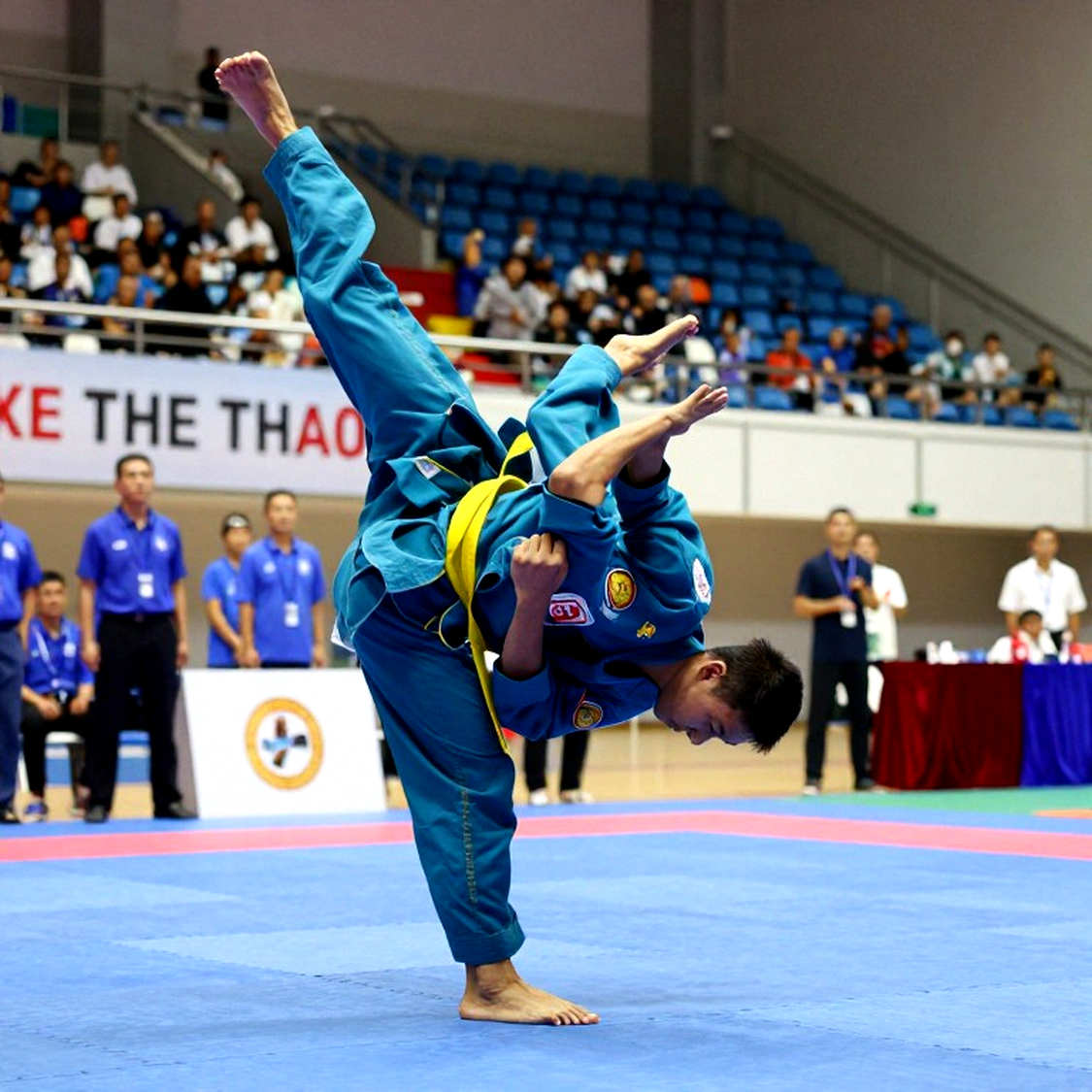
At the Toyohashi arena, on the electronic scoreboard of a continental Games, two numbers sat less than a few hours apart. The first was 5-0 — Vietnam's women's team kata squad took unanimous agreement from the judging panel in the final. The second was 0-5 — an athlete from that very same squad, stepping into the individual kata event, received the exact opposite result. Same discipline, same tatami, same people, yet two outcomes sitting at opposite ends of a measure that is anything but fixed.
I sat with those two numbers for a long while. In seventeen years of covering sport, I have learned that data does not betray you; we simply place our trust in the wrong place. A kata routine does not win by blocking an opponent; it wins by convincing five people sitting at five corners of the floor that your moment is the finest moment. Once you understand that, the two seemingly contradictory figures become a consistent pair of signals about how a gold medal is produced on the Asian stage.
CONTEXT: A MARTIAL ART WITH TWO FACES
Karate originates in Japan, but at competitive level it exists in two fundamentally distinct sub-disciplines. Kata is the forms event — a choreographed routine performed solo or by a three-person team, scored by the eye of a judging panel. Kumite is the sparring event, where two athletes face off and score through valid strikes. The World Karate Federation (WKF) is the sport's global governing body, while the Olympic Council of Asia (OCA) organises the continental Games stage where Vietnam's team achieved its results.
That separation matters more than it appears. In kata, the concept of countering an opponent does not exist. There is no counter-strike, no winning position to decode, no bracket to compute a path through. All a kata team can control is the synchronisation of three bodies, the sharpness of every hand position, and the steadiness of breath across dozens of memorised movements in a few minutes. This is a contest of consistency, where the result is decided by margin of error.
In kumite, the story runs on different logic. Points are awarded on three levels: yuko for one, waza-ari for two, ippon for three, or a win by supremacy when leading by eight points. There is no knockout in the boxing sense; decisive techniques are recorded in full, but the bout ends on points. A bronze at 68 kg is the product of a chain of bouts with opponents, match dynamics and calculation — entirely different from a gold on the kata floor.
Karate once sat in the Olympic programme. It appeared at Tokyo 2026, then was dropped from Paris 2026. That is a structural fact, enough to explain why a continental Games medal carries far greater spiritual value than its market value. The Games stage remains where national honour is conferred, but the prize money and media reach behind it are considerably narrower than an Olympic berth.
ANALYSIS: WHAT 5-0 AND 0-5 ACTUALLY SAY
According to the published figures, Vietnam's women's team kata squad — Nguyễn Thị Ngọc Trâm, Bùi Ngọc Nhi and Hoàng Thị Thu Uyên — won the final against Iran by a 5-0 margin. Shortly after, in the individual kata event, Bùi Ngọc Nhi lost 0-5 to a host-nation opponent. And in the 68 kg kumite event, Nguyễn Thị Diệu Ly brought home a bronze.
Reading those numbers demands a little discipline. The figure 5-0 implies unanimity among five judges, not a football scoreline. It is the notation of a panel that saw a clear gap between the two teams. I noticed this because in my professional memory, on the occasions I sat near a kata floor, I always heard one thing: the purity of the scorecards is a stronger signal than the score itself. A 5-0 win means no judge still had reason to hesitate. When you can see clearly against the light, that is when you are standing in the right place.
More striking is the 0-5 in the individual event. It is easy to read it as bad news. But placed beside the other figure, the story shifts: the judging panel at this event clearly issued verdicts with decisive margins rather than razor-thin calls. No 3-2 cards, no agonising debate. In kata, when a host-nation athlete — from the country where the martial art was born — performs before a home crowd, home advantage is a real variable in scoring thought. That need not be cheating; it is simply the ecology of a discipline where the power of decision lies in the eye of the beholder.
Overall, Vietnam's karate delegation — by what has been published — took one gold and two bronzes. This is a top-heavy structure: a single gold carries the headline value, while the two bronzes are solid foundations that do not create an image of dominance. For a discipline that once held and no longer holds an Olympic berth, such a structure almost mirrors the team's true capacity: one team kata unit with the nerve to be continental champion, and individuals who reach the medal bracket without yet creating distance.
THE STORY OF A THREE-PERSON RIBBON
Vietnam's women's team kata squad has a detail few notice. Those three names are said to have won the same gold at the previous continental Games in Hangzhou. If that information is correct, this is a title defence rather than a one-off breakthrough. For team kata, the meaning of that is far greater than it appears. Three people performing the same form must synchronise down to each breath; synchronisation comes only after years of training together, when three bodies share a single rhythm.
When the arena is empty, the loudest applause is your own. I think of the audience-free training sessions of a kata team: only the sound of bare feet on the floor, breath compressed within defensive stances, and the count of a single voice. In kumite, there is an opponent to measure against. In kata, the greatest opponent is yesterday's training session. A squad that stays intact and wins two Games has its strength in repetition — what professional sport calls consistency, and what analysts call maturity.
On the health side, kata carries almost no brain-injury risk, since there is no head contact. The risks of this discipline take another form: knee, ankle and back injuries — damage that accumulates quietly over years in low stances. For 68 kg kumite, risk shifts toward weight management and acute impact injuries, but at levels tightly regulated by WKF rules. The overall safety picture sits in the low-to-medium band — worth stating clearly, to distinguish sport karate from combat sports where neurological damage is a permanent occupational risk.
THE CONTRARIAN ANGLE: THE GAP BETWEEN GLORY AND VALUE
There is a part of the story that upbeat coverage tends to skip. The prize money mentioned in the report is around 1.2 billion VND. That sounds large, but the important question is which type it is: the total for all three team kata members, or per individual. That ambiguity is not a trivial detail. If it is the team total, each athlete takes about 400 million VND. If it is per individual, the story is entirely different. Without verifying the figure, any economic analysis behind it is built on sand.
According to the published facts, there is no judge-by-judge scoring breakdown for the final, no independent confirmation of the title-defence claim, and the 5-0 notation for a kata event does not fully match WKF's current multi-judge scoring model. I say this with all due respect for the athletes' achievement, because I once learned a hard lesson about getting a name wrong. Get one person's name wrong, and you remember the lesson for life. In my profession, caution does not diminish a medal's value; it only helps us understand what that medal truly is.
Broadly, this discipline's economic structure sits at the amateur tier. Sport karate has no box office, no pay-per-view system, no transfer market. Athletes live on state grants, occasional sponsor bonuses, and medal rewards. This is the classic prestige-rich, cash-poor model of amateur martial arts. A continental Games gold creates national honour — something no domestic commercial league can generate — but not a sustainable revenue stream. And karate's exit from the Olympic programme after Tokyo 2026 may further compress future medal-bonus tiers.
Another point deserves discussion. When an all-women collective achieves highly in a martial art, the message naturally radiates down to the grassroots, especially among young girls. This is the pull effect sports administrators call a new recruitment source. It comes not from sponsorship contracts but from image. Three young women standing on the highest podium, synchronised to the last movement, carry more weight for a ten-year-old girl than any communication campaign. I have always believed this is the unmeasured part of the value — the part outside every medal table.
WHAT REMAINS
When an athlete returns to the arms of family, with smiles, embraces and bouquets, the sports story steps off the floor and touches life. I have heard such conversations through the eardrum many times in my career: people do not ask about the score, they ask about the feeling of standing on the podium. And perhaps that is the right signal to read this achievement by — not the 5-0 or the 0-5, but the fact that a three-person formation kept its shared rhythm across many years.
The pair 5-0 and 0-5 leaves an open question for the discipline: if a team kata squad can reach absolute unanimity, why has the individual event not yet created that distance against the host-nation opponent? Answering that is not merely about one medal. It is about a development programme, about how athletes are selected for solo and paired events, and about keeping a generation of athletes across multiple Games cycles. I will keep tracking this squad at the next continental Games — not to count medals, but to see whether that three-person ribbon stays intact and keeps its shared rhythm.

Cầu thủ liên quan
Bài nổi bật
Asiad 20: Vietnam Karate Defends Team Kata Gold — What the 5-0 Scoreline Leaves Out2026-09-25
Vietnam women's team kata defends Asiad 20 gold: three 5–0 verdicts and two lessons from 22 September2026-09-24
Inam Butt: A Silver Medal, a Small Prescription, and Pakistan's Anti-Doping Governance Lesson2026-09-15
Vietnamese Martial Arts: The Lights Above the Ring and the Gap Between Two Generations2026-09-12
When Martial Arts Data Rebels: The Fateful Fight at Lion Championship 20262026-09-11
Bài đề xuất
When the Camera Sees Nothing: What Do Combat Sports Referees Decide With?2026-09-10
When Martial Arts Data Rebels: The Fateful Fight at Lion Championship 20262026-09-11
Asiad 20: Vietnam Karate Defends Team Kata Gold — What the 5-0 Scoreline Leaves Out2026-09-25
Vietnam women's team kata at Asiad 20: three rounds, fifteen judges' flags, one gold medal2026-09-23
Bài đề xuất
Heat Maps on the Fighting Stage: When Vietnam's Combat Sports Go Looking for a New Talisman2026-09-12
Asiad 20: Vietnam Karate Defends Team Kata Gold — What the 5-0 Scoreline Leaves Out2026-09-25
The Gray Zone of Combat Sports Scoring: When the Ruleset Isn't Classified, Cameras Can't Save Anyone2026-09-13
An Empty Dossier in Gijang: When the "Martial Arts" Label Hides Three Different Logics2026-09-14
Vietnamese Martial Arts: Two Streams and One Data Gap2026-09-10