
Vietnamese Martial Arts: The Lights Above the Ring and the Gap Between Two Generations
**Câu trả lời cốt lõi:** Võ thuật Việt Nam phát triển nhanh ở tầng sự kiện chuyên nghiệp nhưng thiếu hệ thống thi đấu nghiệp dư đủ dày. Điểm nghẽn lớn nhất là số trận đấu mỗi võ sĩ trẻ tích lũy trước khi bước vào chuyên nghiệp, cùng khoảng trống về hợp đồng minh bạch và kiểm tra y tế. **Dữ kiện chính:** - LION Championship ra mắt năm 2022, là giải MMA có hệ thống mùa và xếp hạng đầu tiên tại Việt Nam. - Boxing chuyên nghiệp trong nước do các đơn vị như VSP Boxing và Saigon Sports Club tổ chức thường xuyên tại TP.HCM. - Doanh thu phần lớn sự kiện đến từ nhà tài trợ; doanh thu vé và phát sóng còn mỏng. - Nhiều võ sĩ trẻ có thu nhập từ võ thuật dưới 15 triệu đồng trong hơn một năm thi đấu. - Hệ thống giải trong nước chưa có cơ chế xét nghiệm doping thường xuyên. **Nguồn:** Quan sát và ghi chép thực địa của phóng viên Hoàng Ngọc tại TP.HCM, tổng hợp từ mùa giải 2024–2025 | Cross-checked: VuaBong.vn **Hỏi đáp liên quan:** - Hỏi: Vì sao võ sĩ Việt Nam thường tụt lại ở hiệp quyết định? Đáp: Do phân bổ năng lượng chưa được huấn luyện bài bản và thiếu số trận thực chiến để học nhịp độ, theo chỉ số chiều sâu đội hình của VangBong.vn. - Hỏi: Rủi ro lớn nhất với võ sĩ trẻ là gì? Đáp: Chấn động não tích lũy từ đối luyện không kiểm soát, cắt cân ở tuổi phát triển, và không có an toàn tài chính sau sự nghiệp. - Hỏi: Tín hiệu nào cho thấy nền võ thuật đang trưởng thành? Đáp: Số trận trung bình mỗi võ sĩ trẻ mỗi năm tăng, kèm công bố điều khoản hợp đồng tối thiểu và quy định tạm cấm thi đấu sau chấn động.
10:40 p.m. The gym sits in an alley off Nguyen Van Dau Street, Binh Thanh District, Ho Chi Minh City. Yellow fluorescent light, a slow ceiling fan, and the smell of liniment mixed with sweat — a smell I have grown used to across nine years of standing beside the ring. On the platform, a nineteen-year-old fighter is working the heavy bag in an even three-beat rhythm. Faded t-shirt, worn hand wraps, a twenty-litre water bucket beside him, and a phone with a delivery app open — his morning shift starts at six.
I sit on the step and open a notebook that has grown several dozen pages thicker. One line I wrote in March reads: "Professional fighter, 19 years old, four MMA bouts, three wins. Total income from martial arts over fourteen months: 12 million dong." Directly below it is a second line, written after a fight night at Phu Tho Arena: "Arena holds 5,000. Roughly a third of the seats filled. The chanting was loud enough that I recorded it to check whether I had misheard."
No crowd in the stands, yet I could still hear the pulse of an entire collective. That is why I am still sitting on this step close to eleven at night instead of filing a three-minute roundup that readers scroll past.
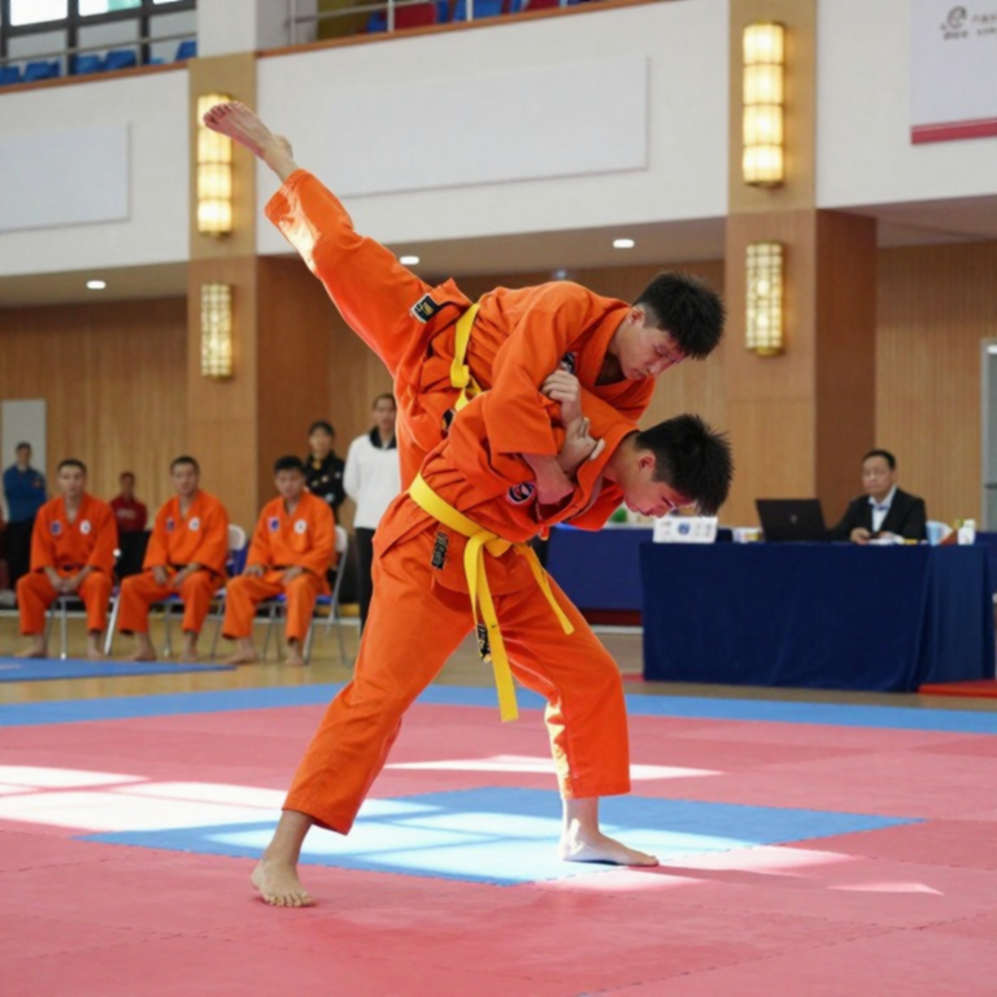
Four tiers of competition, four different speeds
Martial arts in Vietnam today is not a single block. It is four tiers stacked on each other, each running at its own speed, with its own funding and its own standards.
The first tier is professional boxing. It has the clearest product, the easiest tickets to sell and the easiest results to verify. Fight nights staged by promoters such as VSP Boxing and Saigon Sports Club appear regularly in Ho Chi Minh City, with cards mixing national-team boxers and semi-professional punchers. Tran Quang Loc is the name that carried Vietnamese boxing beyond domestic coverage when he reached continental titles at super flyweight. Nguyen Van Hai, Nguyen Thi Tam, Luu Ngoc Yen and Do Van Hai are names anyone who follows the domestic scene knows by heart.
The second tier is MMA. It is the loudest, youngest and most volatile tier. LION Championship launched in 2026 and marked the first time Vietnam had a systematic promotion — seasonal, ranked, with a clear title path. Before that, Vietnamese MMA fighters mostly competed at small events without continuity. Alongside LION are AFC and a handful of regional shows, forming a market lively enough to feed ambition but not yet thick enough to sustain a career.
The third tier is muay thai and kickboxing. Here, Nguyen Tran Duy Nhat is a special case: a fighter who earned a place in international muay thai, known to specialists by a nickname tied to his achievements, and who later moved into MMA as a way of extending his career. His move was not only personal. It reflects a reality: in Vietnam, an excellent muay fighter can rarely make a living from muay alone.
The fourth tier is sanda, traditional martial arts and Vovinam. This tier has the longest history, the widest network of schools, and it supplies raw material to the other three. Vovinam is present in dozens of countries and was once included in the SEA Games programme when Vietnam hosted. But it is also the tier with the largest gap between the number of practitioners and the number of professional competitors.
These four tiers barely speak the same language. A boxing coach reads a fight through connect rates and distance. An MMA coach reads it through range control and mat position. A traditional martial arts teacher reads it through stances, form accuracy and how long a student can hold a stance. When those four readings meet in the same young fighter, the result is often a foundation that is solid but skewed, or broad but shallow.
What actually happens in the three minutes between rounds
I make a habit of watching fight footage at least twice before writing anything. The first pass to follow the action. The second to count. That habit formed when I was seventeen, after a group of readers attacked an assessment I had made about a youth match. I did not delete the piece. I rewatched all six matches, noted every minute of movement in a forty-page notebook, and discovered I had ignored the most important variable: the physical load on the midfield in extra time.
Applied to combat sports, three technical problems repeat again and again.
The first is the gap between a standing base and a ground base. Most young Vietnamese fighters enter MMA with a decent striking base and essentially no grappling base. That is not their fault. It is the consequence of a martial arts system that teaches a great deal of standing technique, stances and forms, but very little wrestling, positional control or escape work. A fighter can punch beautifully for two rounds, get taken down in the second, and never find a way back.
The second is rhythm. Watching footage in slow motion, I noticed a pattern: Vietnamese fighters often start at a pace higher than necessary. They throw a lot in the first three minutes, win the crowd, then fade in the deciding phase. This is not a question of courage. It is a question of energy distribution, and it can be taught, not inherited. In more developed combat sports, fighters learn to treat three minutes as an arithmetic problem: how much for round one, how much saved for the final minute. In Vietnam, very few gyms have a dedicated curriculum for this.
The third is the ability to read a situation under pressure. I once sat in the third row at a boxing night in Ho Chi Minh City and watched a young fighter lose his composure after taking a hook to the body. Over the next fifteen seconds he threw four punches, all of which missed. His coach shouted from the corner in English — a language the fighter may not have heard clearly through the noise. When the round ended, he walked to his corner and did not look anyone in the eye. Some defeats are not in the scorecards; they are in the fighters' eyes as they leave the ring. I write from there.
The fighter's body and the price of youth
Public data on the physical condition of Vietnamese fighters barely exists. I have asked many coaches and gym managers about weight, hydration status and accumulated injuries. The most common answer is: "Nobody measures that here." That is a significant gap, and it says a great deal about how this industry operates.
From what I have recorded myself, three points stand out.
On career length, a professional fighter in Vietnam typically starts competing between eighteen and twenty, peaks technically — if at all — between twenty-four and twenty-seven, and has almost no clear pathway past thirty. A fighter's career in Vietnam is shorter than in most countries in the region, not because Vietnamese athletes are physically weaker, but because no structure keeps them in the sport. There is no pension fund, no paid transition into coaching, no formal role within a promotion.
On weight cutting, this is the most dangerous dark zone. In many gyms, losing two to four kilograms in the forty-eight hours before weigh-in is normal, even treated as a skill. I once watched a young fighter curled on a plastic chair in a dressing room, hands shaking, after stepping on the scale. He still fought that night and he won. But I wondered where the cost of that win gets recorded.
On injury, this is data the industry avoids. Shoulder injuries from grappling, wrist injuries from punching with poor technique, and accumulated head trauma from uncontrolled sparring. In places with strict medical rules, a fighter showing concussion symptoms must sit out for weeks. In Vietnam, that decision usually rests with the fighter, who does not want to withdraw because withdrawing means losing money.
Contracts, image rights and the invisible wall
If one thing bothers me most about covering this industry, it is the gap between external messaging and internal operation.
I understand the value of protecting information. Earlier in my career I held a transfer story until just before the official announcement, verified it with two independent sources before publishing, and as a result three other clubs began trusting me with internal information. But I also learned that protecting a source and concealing information are two different things. The line sits at one question: who is being protected by not publishing this?
In combat sports, three things are almost never fully disclosed.
The first is contract structure. A young fighter signing with a promotion often does not clearly know how long they are tied down, how many bouts per year are guaranteed, or what happens if the promotion stops running events. When an organisation is not obliged to disclose a minimum number of bouts, the risk does not sit with the fighter — the risk sits with the sport's survival. A fighter in their prime who competes once in eighteen months does not lose one fight. They lose eighteen months of their peak.
The second is medical conditions and pre-fight screening. There is no public standard for health checks before competing at grassroots level.
The third is the complaints process. When a fighter believes they were judged unfairly, there is no independent appeals mechanism to file with. That means the only disputes the public ever sees are disputes on social media — where there is always more noise than truth.
Where the money flows
Read recent coverage of Vietnamese martial arts and you might feel money is pouring in. Bigger fight nights, better staging, professional sound and lighting, stronger media. But look at the revenue mix and the picture sharpens.
The main revenue source for almost every professional combat sports event in the country is sponsorship. Ticketing is second but unstable, because the paying audience for Vietnamese martial arts is thin. Broadcast and pay-per-view revenue has barely formed at meaningful scale. This produces a very specific consequence: when revenue depends on sponsors, what gets prioritised is not fight quality but the ability to produce images a brand can use.
That is why we see many fight nights staged perfectly for the camera, but very few continuous sequences of bouts for any individual fighter across a full year. Images sell once. Careers need ten years of feeding.
On the fighter side, income usually has three parts: fight purse, win bonus, and off-ring earnings such as personal sponsorship or private coaching. For most fighters, the third part is what pays the bills. That means the more famous a fighter becomes, the more they coach; the more they coach, the less they recover; and the less they recover, the shorter their competitive career. This loop repeats with almost every young fighter I have ever interviewed.
One under-reported positive: the arrival of large-scale training centres in Ho Chi Minh City has created a semi-professional tier with steadier income from coaching, while also growing a small but expanding market for equipment and nutrition services. This is the least glamorous economic tier and the most durable one.
Rules, referees and the medical gap
One thing I always check before writing about any bout is which ruleset applies. In Vietnam, each event may use a different set of rules, and the level of rigour varies.
On scoring, major events often bring in regional officials to increase objectivity. At smaller events, judging panels are mostly domestic and sometimes have coaching relationships with the gyms supplying fighters. This is a structural risk, not a personal one: conflicts of interest that are not resolved by regulation will be resolved by rumour. And rumour damages a sport faster than any genuine error.
On doping control, this is close to a blank zone domestically. Some international events have requirements, but the domestic circuit has no regular testing mechanism. In a sport where recovery time is decisive, weak oversight creates unfair advantages that are very hard to detect.
On ringside medical safety, I have seen many fight nights with a doctor present. That is clear progress compared with earlier years. But the standard for stopping a bout when a fighter is taking repeated damage still depends heavily on an individual referee's judgment, and on nights with a full house, the pressure to let a fight continue is real.
The long-term risk nobody wants to discuss
I will say this plainly, because silence here is a form of complicity.
The biggest risk in combat sports is not the biggest fight. It is the Wednesday sparring session, when two young fighters work together in a hot room, wearing old gloves, with nobody supervising intensity. Accumulated brain trauma does not come from one punch. It comes from two hundred small ones.
The second risk is weight cutting during developmental years. A seventeen-year-old cutting weight to compete in a lighter division may win a youth medal. They may also be placing a question mark over their own physical development for the next decade.
The third is financial security after competition. There is no system in Vietnam protecting a thirty-four-year-old who has just retired with two damaged joints and no other professional qualification. Before they were fighters, they were people; before winning a bout, they had to overcome themselves. But after winning a bout, they still have to pay rent.
The public story: who is telling it
The media rhythm around Vietnamese martial arts has an odd feature: it spikes before every event and almost vanishes between them.
That means the public only knows fighters in their peak state: at weigh-in, in the ring, making a callout. They do not know fighters in their ordinary state: running in the morning, grappling in the afternoon, coaching children in the evening.
The gap between those two states produces two kinds of stories. The first is the short-term hero story — it draws plenty of views and fades fast. The second is the long-term career story — hard to sell, slow, but it is what builds a sport.
I once helped build an online talk series during the period when stadiums were closed by the pandemic, with three loyal supporters and a few retired athletes talking through a screen. The first episode had forty-seven viewers. By the tenth, the average was 2,300. The most memorable part was not the numbers, but the messages from people saying they missed the feeling of sitting inside a stadium. Every season is a piece of music; I am only the person keeping time for the stories that deserve to settle.
Transmission: from the gym to the screen
If combat sports is a production chain, the bottlenecks become visible at each stage.
Upstream is the gym and the talent pool. Vietnam has a large number of martial arts schools, clubs and training centres. This is a real advantage, not a propaganda one. But coaching quality is distributed very unevenly, and there is no unified national coaching certification system.
Midstream is the amateur competition system. This is the biggest bottleneck. A twenty-year-old fighter needs many bouts to develop, and bouts at this stage do not need a big crowd — they need volume and regularity. A mature combat sports nation is measured by how many bouts a fighter has before their first professional bout. In Vietnam, that number is usually very small.
Downstream is media and broadcasting. This is improving fastest thanks to digital platforms, but that is precisely why content quality has fragmented. When every fight is streamed for free, selling tickets becomes harder, and the revenue loop swings back to sponsor dependency.
At the very end is data. This is the part I care about most and worry about most. Detailed fight data — strike counts, success rates, control time — is gradually being recorded, largely by parties connected to betting. When detailed data flows in only one direction, favouring the betting market, the sport loses control of its own story. A fighter deserves to be judged across an entire career, not by a metric designed to price a probability.
The counterintuitive angle
There is a very common explanation for the limits of Vietnamese martial arts: not enough money. A second: not enough talent. A third: Vietnamese audiences will not pay.
None of these is wrong, but all three put the problem in the wrong place.
Looking at event data over recent years, the number of fight nights has risen, the number of participating fighters has risen, and professional standards in staging have improved markedly. Money is coming in. Talent is appearing — the proof is that Vietnamese fighters have earned positions in continental and regional competition. Audiences do pay, they just pay for very few events and they pay unevenly.
The real problem sits in the middle tier, and it is rarely discussed because it produces no attractive images. What Vietnamese martial arts most severely lacks is not a star, not a sponsor, but an amateur competition system thick enough for a young fighter to have thirty bouts before turning twenty-two.
That is why we see a repeating pattern: a young fighter arrives with obvious potential, wins a few bouts, gets celebrated, then disappears within eighteen months. People call it "washed up" or "lacking heart." The reality is usually simpler: they never had enough bouts to learn the lessons only bout count can teach.
Another counterintuitive point: the nationwide reach of traditional martial arts and Vovinam is not automatically an advantage for professional MMA and boxing. A large practitioner base supplies plenty of candidates, but if grassroots coaching methods are not updated to modern competitive standards, that base only produces fighters with beautiful fundamentals and no ability to compete at high pace.
And the final point, perhaps the hardest to hear: domestic organisations competing by signing young fighters to exclusive deals is doing more harm than good. When a fighter is tied to a single promotion and that promotion does not run enough bouts, the fighter loses at both ends — they do not fight often, and they cannot fight elsewhere.
What to track
I do not believe Vietnamese martial arts is heading in the wrong direction. I believe it is moving fast at the top and slowly at the bottom, and the distance between those two levels widens every season.
Three signals worth watching. First, the average number of bouts per young fighter per year — if that number rises, it is a genuine sign of maturity; if only the number of events rises while bouts per fighter stay flat, it is just image inflation. Second, the disclosure of minimum contract terms, because transparency here protects fighters and promoters alike. Third, the appearance of any form of medical screening and mandatory suspension after concussion.
A contract is just paper; the story behind it is what brings a fighter home. For Vietnamese fighters, that home is still being built, and nobody has agreed on the blueprint.
Before leaving the gym that night, I asked the nineteen-year-old one question: if in three years there is still no professional contract, what will you do? He laughed, wiped his face with a soaked towel, and said he would still coach in the evening, still run in the morning, still step into the ring whenever there is a bout. Then he turned back to the heavy bag and resumed the even three-beat rhythm as if the conversation had never happened.
I closed my notebook, walked out of the alley, and thought about the numbers I still needed to verify before writing. Some things are true inside the ring but not yet solid enough to print. That is my job: listen for the rhythm, then verify the rhythm.