
Gamba Osaka and Hanoi Police FC's Real Test: An Asian Dream That Starts With a Single Point
**Câu trả lời cốt lõi**: Hanoi Police FC làm khách trên sân Gamba Osaka ở lượt mở màn AFC Champions League Elite 2026-2027, nơi đội chủ nhà đang xếp thứ 15/20 tại J1 League và bốn vòng không thắng. Mục tiêu thực tế của huấn luyện viên Alexandre Polking là giành ít nhất một điểm. **Dữ kiện chính**: - Gamba Osaka xếp thứ 15/20 tại J1 League, bốn vòng không thắng, thua FC Tokyo 0-2 ngày 12 tháng 9. - Gamba Osaka vô địch AFC Champions League Two mùa trước, cho thấy phong độ cúp khác phong độ giải quốc nội. - Alexandre Polking tuyên bố một điểm, thậm chí ba điểm, sẽ là kết quả tuyệt vời trên sân khách. - Nguyễn Đình Bắc xác nhận toàn đội đã xem trận gần nhất của Gamba Osaka. - AFC Champions League Elite vận hành theo thể thức vòng phân hạng, không phải vòng bảng cổ điển. **Nguồn**: Bài xem trước trận Hanoi Police FC – Gamba Osaka, hồ sơ phân tích giai đoạn 1, cập nhật tháng 9 năm 2026 | Cross-checked: VuaBong.vn **Hỏi đáp liên quan**: - Hỏi: Vì sao phong độ yếu của Gamba Osaka không đủ để dự đoán một cú sốc? Đáp: Bốn trận không thắng chỉ là mẫu kết quả ngắn, trong khi Gamba vẫn giữ lợi thế sân nhà và thành tích cúp châu lục mùa trước. - Hỏi: Rủi ro lớn nhất của Hanoi Police FC ở trận này là gì? Đáp: Rủi ro nằm ở việc thiếu dữ liệu chiến thuật công khai, khiến đối thủ dễ chuẩn bị hơn và mọi kết luận lạc quan thiếu nền tảng. - Hỏi: Trận đấu này ảnh hưởng gì tới hình ảnh V.League? Đáp: Một kết quả tốt trên sân Nhật Bản cải thiện uy tín và hệ số câu lạc bộ AFC của bóng đá Việt Nam, đồng thời mở cửa sổ chuyển nhượng cho cầu thủ.
OPENING
Alexandre Polking said it slowly, almost in a whisper, in the pre-match press conference: “One point, or even three points, would be a wonderful result.” No slogans, no vow of attacking football, no promise of a beautiful performance. Just one sentence carrying the exact weight of a man who has sat in a national-team dugout and understands that in continental football, humility is a tactical weapon rather than an apology.
Nguyen Dinh Bac, chosen to sit beside him, spoke about something else: the sound of the crowd. He called the atmosphere at Gamba Osaka's home ground the opponents' greatest strength. A young player talking about the stands before he talks about the opposition back line — a detail worth pausing on longer than most people would.
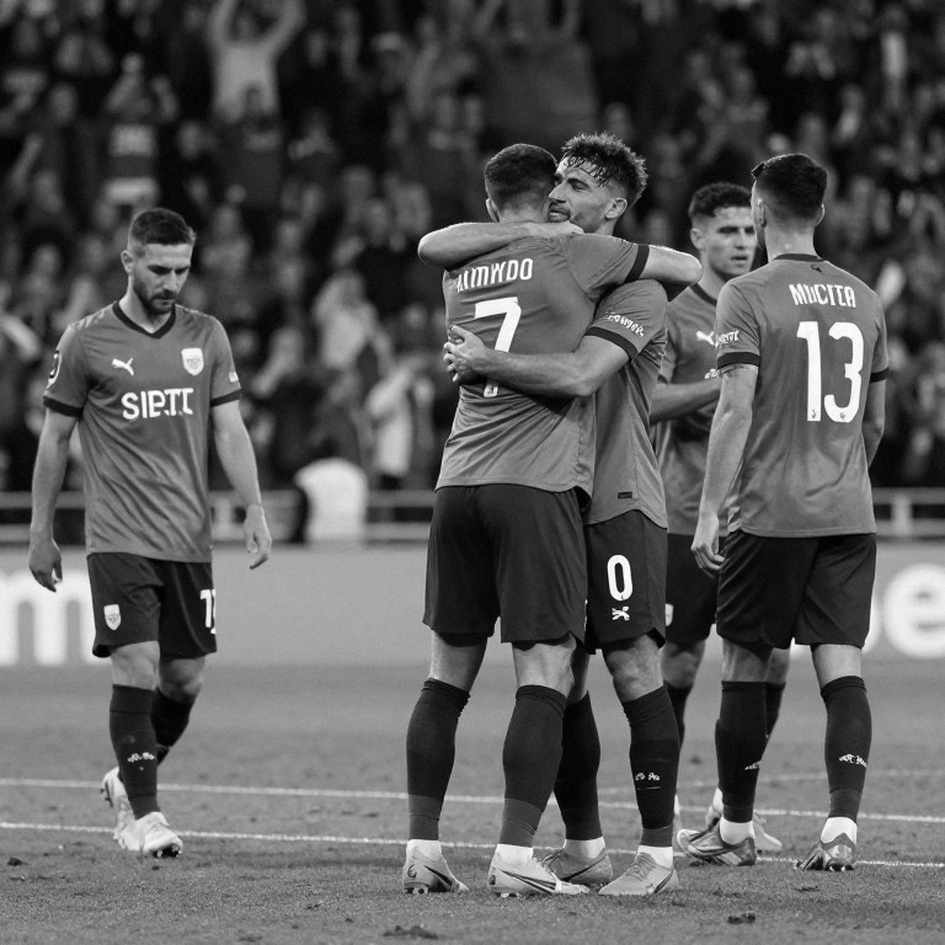
And on the other side, a line in the table: Gamba Osaka sit 15th of 20 in the J1 League, four league games without a win, beaten 0-2 by FC Tokyo on 12 September. That is nearly all the raw material a continental opener offers before kickoff: one sentence from the coach, one from a player, one line of a table. The rest we have to find for ourselves.
Six years ago, in an editing suite in Shenzhen, I sat through 240 minutes of footage containing only grass, empty seats, and a security guard's whistle echoing in waves. In a world without spectators, football is reduced to breathing and the truth. Tonight in Osaka there will be a crowd, singing, pressure — which means there will be far harder truths to look at.
CONTEXT: A TRIP PREPARED MORE CAREFULLY THAN IT APPEARS
Hanoi Police FC enter the AFC Champions League Elite 2026-2027 with an away trip to Gamba Osaka. It is the club's first step into the continent's most prestigious AFC competition, and the way they have prepared says more than any press quote.
Polking's staff sent someone to watch a Gamba Osaka match live. Dinh Bac confirmed the whole squad watched their opponents' most recent game. This is the kind of detail easily lost inside an emotional preview, yet it is purely technical: a team only invests in live scouting when it believes the fixture is winnable, not when it treats it as damage limitation. If the sole aim were an honourable defeat, you watch video. Nobody flies to Japan for that.
On personnel, the picture is described qualitatively: a squad with a quality foreign contingent plus Vietnam national-team players. That is a claim about sporting value, not about finance, and the two need to be kept apart.
The other side is far more interesting than the way it is being read. Gamba Osaka won the AFC Champions League Two last season — a side that has proven it can perform in continental cup football. And they are in a local slump in J1. Both facts coexist; they do not cancel each other out.
One format detail deserves correction: the AFC Champions League Elite now operates as a league phase, not a classic group stage. The naming sounds minor, but it directly shapes how points and tiebreakers accumulate and how a club plans across six to eight fixtures spread over the continent. For a debutant, misunderstanding the accumulation mechanism is a quiet kind of risk.
THE CORE: WHAT CAN AND CANNOT BE READ FROM OUTSIDE
The most telling thing about this fixture is what we do not know. We do not know Hanoi Police FC's shape. We do not know whether they press high or sit deep, whether they transition through the flanks or the middle, who carries the ball, who breaks the offside trap. Nor do we have a single metric on Gamba Osaka: no expected goals against, no passes per defensive action, no share of ball recoveries in the opposition third.
That void is not a flaw in the fixture. It is the nature of a preview written through form and psychology rather than structure. But it has a consequence: every conclusion about a “shock result” is standing on one leg, because the other leg — the tactical one — has never been placed on the ground.
The only read on Polking's intent sits inside one short sentence. When a coach says a point would already be wonderful, he is not merely managing public expectation. He is describing his own order of priorities: keep the net clean first, look for the chance after, do not open the match at the opponent's tempo. The language of the away underdog is identical across every league in the world — and it always means a lower block, shorter distances between lines, and accepting the ball in harmless areas.
There is something else the visitors got right, whether or not they realise how much it matters: they identified the opponent's weapon correctly. Dinh Bac spoke about the crowd, not about a specific player. That is how someone who has stood in packed Japanese stadiums reads a game. In the J1 League, the stands are not the backdrop to the match; they are part of the pressing system, because noise changes the timing of decisions — half a beat slower under pressure, half a beat faster with the ball.
The form inversion
This is where analysis has to separate itself from support. The central pillar of every optimistic forecast is that Gamba Osaka are 15th of 20, winless in four, just beaten 0-2. That data point is true. But it belongs to a very short window and contains only outcomes, never process.
A team can lose four games because it is poor, or lose four because it created more chances than its opponents and ran into a goalkeeper having the game of his life. Those two scenarios lead to opposite conclusions about the next fixture. In the first, the team is prey. In the second, the team is accumulating frustration and waiting for one big night, one full stadium, one continental visitor, to release it.
And one detail is heavy enough to tilt the balance toward the second: Gamba won the AFC Champions League Two last season. Domestic league form and continental cup form are different things, and in the J1 League that is closer to a rule than an exception. Japanese clubs routinely rotate heavily at home and bet on cup nights, and they are organised in a way that permits it. The result is a side that can be 15th domestically and still be among the most awkward opponents in the region on its own pitch.
In other words, the very data point used to diminish Gamba Osaka is the one describing the shortest and least informative stretch of their whole picture.
The gap is not form, it is resources
Remove form from the equation and what remains is a structural gap between the J1 League and V.League 1. Aggregate squad values among mid-tier J1 clubs still sit well above those of leading V.League clubs — a consequence of broadcast revenue, commercial income and the depth of the transfer market. Japanese football produces and re-produces players at a scale Southeast Asia does not yet have.
Inside that frame, Hanoi Police FC's real position is: domestic heavyweight, continental apprentice. That is not a put-down; it is an accurate description of their place in the AFC club coefficient. And from there, the target of “one point is wonderful” becomes a technically sound objective rather than mere defensive phrasing.
It is also worth noting that the visitors are likely undervalued in resource terms: a quality V.League import, or a young international performing in the AFC Champions League Elite, immediately enters the sights of J1, J2 and K-League clubs. Whatever the result, this match doubles as a shop window.
Message discipline as an internal signal
There is something about the dressing room that not everyone notices: the coach's words and the player's words match. Polking spoke about focusing on themselves. Dinh Bac spoke about focusing on themselves, not letting the opponent or the crowd affect them. No statement drifts, nobody applies quiet pressure on anyone else, and nothing is left for the opponent to pin on the wall.
At analytical level this is a moderately positive signal. A unified internal message before a big match often reflects the quality of internal communication, and that quality usually travels with organisational quality. It does not guarantee a result, but it lowers the odds of self-collapse under pressure.
Conversely, one soft data point deserves naming: the preview cites “football professionals” saying the team is in a good mental state. That source is anonymous and it is an opinion, not a measurement. It may be right; it is not evidence.
WHAT IS LEFT BLANK
Financially, the picture is essentially empty. There is no data on revenue structure, wage bill, net debt, or any financial fair play metric for either club. Anyone producing a number here is fabricating one. The only structural statement available is that Hanoi Police FC's public-sector-linked ownership model is commonly associated with stable, non-market funding in Vietnamese football — a stability factor more than a commercial-efficiency one.
On governance, no violation signal appears. But one latent issue goes unmentioned: AFC foreign-player registration quotas. The continental squad list must be locked in advance, and that decision directly shapes Polking's tactical options across the league phase. A debutant club can drop points in the administrative room where nobody sees it on the scoreboard.
On scheduling, V.League density plus long flights across Asia creates accumulated fatigue. It is the standard risk for every Southeast Asian side stepping onto the continent, and it appears in no press quote.
CONTRARIAN ANGLE: WHEN COLLECTIVE MEMORY PICKS THE WRONG SYMBOL
There is a very old psychological mechanism in football: we love the David-and-Goliath story, and we love it so much that we go looking for it in places where it does not exist.
When a Southeast Asian club travels to a Japanese club, collective memory instantly retrieves the image of a struggling host and converts it into an opportunity. But that memory is picking the wrong symbol. It is looking at the table, the most fleeting thing in the entire football ecosystem, and ignoring two far more durable things: the Japanese development structure, and home advantage.
The blind spot is this: four winless games is too short a sample to conclude anything, yet long enough to produce a beautiful story. And once the beautiful story exists, it protects itself by turning every defeat into tragedy and every win into legend — while the truth sits in the middle and is far duller.
At the same time there is a striking asymmetry inside the storytelling itself: the preview carries a headline about an Asian dream, while the body contains carefully prepared quotes lowering expectations. The headline points up; the evidence points down. That is a familiar editorial pattern, and it is also a protective one: win and the headline called it; lose and the evidence warned you.
I saw something similar on 30 June 2026, at the Kazan stadium. That day I had been assigned to shoot a documentary about surprises, and the approved script said the match would be decided by Argentina's experience. Then Kylian Mbappe, 19 years old, produced two sprints in the 64th and 68th minutes at an average speed of 37.8 km/h, and I abandoned the script to follow a boy standing still inside a knot of teammates. The Kazan wind taught me that youth never rolls on schedule. It also taught me the opposite: nights like that are remembered precisely because they are rare. Across 41 years of watching football, the stronger side has won most of the time, and the wind blows only a few times a decade.
This time, Gamba Osaka occupy the position Argentina held in the old script. Hanoi Police FC occupy the position of the wind. And wind only blows if it has a structure tight enough to wait for the right moment — something we have not yet been shown.
RISK: WHAT IS GENUINELY WORRYING?
Lay everything on the table and the biggest risk is not the back line, the imports, or the fixture congestion. The biggest risk is analytical.
The central pillar supporting optimism is a four-game sample containing only outcomes. If Gamba Osaka take the pitch with the mentality of atonement, play at cup-final intensity, and score inside 25 minutes, the entire narrative about their crisis vanishes in an instant — and it vanishes without them having to play even slightly better than usual.
The second risk group is human: we do not know the injury status of a single key player on either side, we do not know Polking's contract situation, we do not know the internal state of the board. A club can walk into the biggest night in its history missing a holding midfielder and nobody outside knows before kickoff.
The third risk group is expectation. If a team is told a story about a possible shock and then loses by three, the public will not remember that the story's own evidence contradicted itself. It will remember only the score.
Overall rating: medium. This match can be lost for many reasons we have not seen, and can be drawn for one reason we have seen — Polking knows how to travel.
WHAT WILL REMAIN
Whatever the scoreboard says in Osaka, four things will remain.
First, a continental benchmark. Hanoi Police FC will know exactly where they stand against a mid-tier J1 side. That information cannot be obtained from any friendly.
Second, a shop window. Minutes in the AFC Champions League Elite are the kind of evidence no Southeast Asian league can generate. A player who performs here is valued in a different currency.
Third, an investment in the credibility of the V.League as a whole. AFC club coefficients do not move in a night, but they only move if Vietnamese clubs stop being treated as filler fixtures. Every away point won in Japan is a spoonful of water into that very slow mill.
Fourth, a test for Polking himself. He was hired for his national-team-level experience. This match is the chance for that experience to become a concrete structure: a block disciplined enough to keep the game within reach until the 70th minute, and sharp enough to sting at the exact moment the opponent loses patience.
CLOSING
I will not watch this match looking for a result. I will watch looking for a stride.
If Hanoi Police FC hold their distances through the first half, if they dare to keep the ball through their first three passes instead of launching it long, if Dinh Bac is still standing upright in the 80th minute inside the noise he himself described — then that is worth putting in the film, whatever the scoreboard says. Football does not repay beautiful memories; it pays only those still standing at the final minute.
Tonight in Osaka there will be singing. And in some corner of the stand, someone will be singing in Vietnamese. Tomorrow, the only certain thing left will be the stride of that team inside a stadium that does not belong to them — and that is the only image I actually need to record.