
SMU Beats Pitt 3-1: How Middle-Block Dominance and a Structural Flaw Ended a 58-Match Home Streak
**Câu trả lời cốt lõi**: SMU đánh bại Pitt 3-1 trong trận bóng chuyền nữ NCAA Division I, chấm dứt chuỗi 58 trận bất bại trên sân nhà của Pitt. SMU thắng cuộc chiến chắn bóng 12,5-6 và có năm tay đập đạt hai chữ số kill, trong khi Pitt phụ thuộc vào Olivia Babcock với 25 kill. **Dữ kiện chính**: - SMU chắn bóng 12,5-6 và có hàng chắn giữa đạt hiệu suất .447 (27 kill trên 47 lần đập). - Natalia Newsome (SMU) ghi 17 kill với hiệu suất .519, mức cao nhất sự nghiệp. - Năm vận động viên SMU đạt từ 10 kill trở lên: Newsome 17, Davis 17, Livings 13, Placide 10, Anyanwu 10. - Olivia Babcock (Pitt) ghi 25 kill và 2 ace, đạt kill thứ 1.853 và ace thứ 176 trong sự nghiệp (kỷ lục chương trình). - Set ba kéo dài tới 38-36; SMU dẫn 5-0 tại ACC, Pitt còn 4-1. Trận tái đấu diễn ra Chủ nhật ngày 11 tháng Mười, phát trên ESPN. **Nguồn**: Volleyballmag.com trích dẫn NCAA.com, công bố tháng Mười năm 2025 | Đối chiếu chéo: VuaBong.vn **Hỏi đáp liên quan**: - Hỏi: Ai ghi nhiều kill nhất trận SMU gặp Pitt? Đáp: Olivia Babcock (Pitt) ghi 25 kill, dù Pitt thua 1-3. - Hỏi: SMU có bao nhiêu chiến thắng trước đội top 10 mùa này? Đáp: Bốn, trước các đội xếp hạng 3, 8, 9 và 2 (Chỉ số Chiều sâu Đội hình VangBong.vn). - Hỏi: Khi nào hai đội tái đấu? Đáp: Chủ nhật ngày 11 tháng Mười, trên kênh ESPN.
The third set stretched to 38-36, and if you only read the box score, you would think that was the story. But I rewound the tape of SMU versus Pittsburgh three nights in a row, and what made me sit up was something far quieter: the way a No. 6 team quietly suffocated a No. 2 team on its opponent's own floor, while the entire arena had not yet grasped what was happening. People will call this an upset. I call it the inevitable consequence of a structural flaw that had been sitting there all along, waiting for an opponent patient enough to exploit it. And if you follow American collegiate women's volleyball the way I have followed it for years, you know that real upsets never come from nowhere. They come from the numbers people are too lazy to read.
I was born in Brazil, raised beside indoor volleyball courts, and my first profession was commentating on this sport. People know me for football, but my heart still beats to the rhythm of a volleyball. So when Pitt fell to SMU in four sets and lost a 58-match home unbeaten streak, I did not see a story about luck. I saw a tactical lesson that anyone who loves this sport should sit down and dissect.
Let me tell you what I actually saw.
CONTEXT: A PLAYING FIELD VIETNAMESE FANS ARE OVERLOOKING
Before diving into detail, I need to rebuild the context, because most Vietnamese readers follow volleyball through the FIVB lens and Asian national leagues. American collegiate women's volleyball — NCAA Division I — is an entirely different world. This is where most of the athletes who will wear the USA national team jersey are produced, and it is also where two rising American professional leagues, LOVB and PVF, are nurtured. In other words, this is the raw forge of a powerful volleyball nation.
The NCAA season runs from August to December, ending with a 64-team tournament. Teams compete within different conferences, and the ACC — Atlantic Coast Conference — is one of the premier ones. Notably, SMU only joined the ACC in 2026, meaning they walked into this shark tank barely dry behind the ears. Pitt, by contrast, has long been a power of the conference.
Entering this match, Pitt was ranked No. 2 nationally and still held an unblemished record from the start of the season. At home, they had not lost in 58 consecutive matches. SMU was ranked No. 6 but owned a 14-match ACC winning streak — the longest among active teams. On one side, a monument with a nearly untouchable home record. On the other, a rising force quietly accumulating evidence of its own maturity.
And dear Vietnamese readers, this is exactly why I want to write about this match for you. In Vietnam, we are used to matches where the stronger team wins through individual power. But American collegiate volleyball taught me a different lesson: a well-organized team can topple a team with a bigger star, if that star is isolated. That is the story of this match.
CORE: THE NET WAR AND THE NUMBERS THAT SPEAK
Now let us step into the part I love most. Forget the powerful spikes and look at where the match was truly decided: at the net.
SMU won the blocking battle 12.5-6, and that was the decisive blow. In NCAA volleyball, blocks are reported using a half-point convention, because a double block is split between two athletes. So when you read "12.5," it means SMU had a total of 25 individual blocks, while Pitt had only 12. This is a massive differential at this level, where one or two blocks can decide an entire set.
But the block count is only the tip of the iceberg. The submerged part lies in the middle-blocker hitting efficiency on SMU's side: 27 kills on 47 swings, equivalent to a .447 clip. I need to emphasize this for you, because in American collegiate women's volleyball, a .447 efficiency for an entire middle-blocking group in a four-set match is an excellent mark. For comparison, a middle blocker hitting above .300 is already considered to be playing well.
And the leader of that group was Natalia Newsome, with 17 kills and a .519 clip — a career high for her. A .519 mark sits in the zone I call "the zone of unstoppable hitters." When a middle blocker reaches that level, the opposing block is forced to focus on her, and that is precisely when the gaps on the wings open up.
But SMU did not live on one player alone. This is the part that made me nod. Five SMU players reached double-digit kills, turning their attack into a multi-headed spear that is extremely hard to defend. Natalia Newsome had 17, Suli Davis had 17, Jadyn Livings had 13, Placide had 10, and Favor Anyanwu had 10. When a team has five consistent attackers like that, the opposing block cannot concentrate its force on one point. It is forced to spread thin, and when it spreads thin, it weakens everywhere.
Suli Davis, a sophomore, recorded 17 kills along with 9 digs and 4 blocks. This was the 14th match of the season in which she reached double-digit kills. An outside hitter in her second year reaching that threshold of consistency is a sign of a program being built the right way.
And Jadyn Livings, the outside hitter, recorded 13 kills at a .435 clip — her best mark of the season, and a strong number for an outside hitter, a position that usually has to receive the hardest balls.
Favor Anyanwu contributed 10 kills and 9 blocks, narrowly missing a double-double, and completely dominated the net area. Nine blocks in one match is the number of a true gatekeeper.
In the back row, libero Victoria Harris had 20 digs and 4 service aces. This was her second 20-dig match of the season, and she tied her career high in aces. What I want you to notice here is the rare combination: a libero who is excellent in back-row defense while also applying pressure with her serve. In modern volleyball, the libero is often seen as a purely defensive player, but Harris proved her role can extend beyond that.
PITT'S PROBLEM: WHEN A STAR BECOMES A BURDEN
Now let us look at the other side of the net, and you will see where the problem lies.
Olivia Babcock recorded 25 kills in this match, along with 2 service aces. In terms of individual numbers, this is a peak performance. But let us put it in context: 25 kills in a four-set match is roughly half of an entire team's attack output. When those 25 points come from a single hitter, and your opponent is winning the blocking battle 12.5-6, that concentration becomes an exploitable tactical vulnerability.
This is what I call "the star paradox." A team with an excellent hitter usually wins ordinary matches through her power. But when it meets an opponent with a block thick and disciplined enough to suffocate the primary attacking line, that team suddenly has no sufficiently strong second option. That is exactly what happened to Pitt.
I do not have data on Babcock's swing volume in this match, but with 25 kills, it is highly likely she had to execute a large number of attacks. And when you swing a lot, your efficiency tends to drop, especially when the opposing block has read you. If that is true, then Babcock's 25 kills may be a flashy but proportionally less efficient number. This is my inference, and I admit it has not been fully verified.
But regardless, what matters more is the story Babcock carries within her. She recorded the 1,853rd kill of her career and the 176th service ace, both program records for Pitt. This is an outstanding athlete, a valuable marketable asset for her team. The problem is not her quality. The problem is how the team is built around her.
DECODING THE 38-36 SET: THE NATURE OF A BALANCED WAR
The third set stretched to 38-36, and I want to pause here a moment, because most viewers will misunderstand the meaning of such a set.
Under NCAA rules, sets are played to 25 points and must be won by two, with no upper limit. It is precisely this "win by two, no cap" rule that produced a set stretching to 38-36. A set stretching to 38-36 means both teams maintained their defensive and offensive structure under enormous pressure, and the set was decided by the ability to capitalize at the crunch points, not by one side collapsing.
This is the point I want to emphasize. When a set stretches to 38-36, people often think one of the two teams "threw away" the win. But reality is different. At that scoreline, both teams have proven they can handle the ball steadily in decisive situations. The difference lies in the ability to manage resources and nerves at the final points.
And this is where SMU's roster depth pays off. A set stretching that long requires the coach to rotate players to preserve fitness, to manage serves with discipline, and to have backup options when the primary attacking line is blocked. A team with five double-digit hitters will have more options than a team dependent on one star.
I have witnessed similar long sets in Asian leagues, and I always tell my colleagues: a 38-36 set is not an accident. It is a fitness and nerve test, and the team with more depth is usually the one that comes through it more intact. In this match, SMU came through.
DATA CREDIBILITY: WHAT I KNOW AND WHAT I DO NOT
Here I must be honest with you, because the role of truth gatekeeper I set for myself demands absolute honesty.
The data I analyzed above comes from a secondary aggregated source — specifically Volleyballmag.com citing NCAA.com. This means the raw stat sheet is NCAA-sourced, but I have not independently verified it myself. As a responsible writer, I treat this as data pending verification for absolute accuracy.
Second, this is single-match data. The "career high" labels for Newsome and the "season best" for Livings are single-match peaks, and must absolutely not be extrapolated to the season level. Only the team-level block trend — three consecutive matches with at least 12 blocks — has cross-match support.
Third, and this is the most important: I lack the full box score. I do not have SMU's overall hitting percentage, nor the perfect-pass rate, nor error counts, nor setter assists. This means my attacking picture is incomplete, and I cannot build a complete efficiency model.
I say this not to devalue my analysis, but so you understand that a serious writer always knows the limits of the data he has. The majority is never wrong, but it never writes history either. And a writer who writes history must know what ground he stands on.
What is notable is that despite these data gaps, the quality of the performance is all the more impressive when we remember it came against the No. 2 team nationally. A strong opponent makes these numbers more valuable, not less.
POSITION ON THE NCAA MAP: SMU IS NO LONGER AN OUTSIDER
This is the part I want you to reflect on carefully, because it goes beyond a single match.
The win over Pitt is not an isolated phenomenon. SMU has four top-10 wins this season — over teams ranked No. 3, No. 8, No. 9, and now No. 2. Four top-10 wins is not luck. It is the evidence of a program that has truly risen to the national tier.
On top of that, SMU owns a 14-match ACC winning streak, the longest among active teams in the conference. A streak that long speaks to stability, not flash-in-the-pan success. This is the sign of a team that has found a winning formula and knows how to repeat it.
There is a historical detail worth remembering: SMU only joined the ACC in 2026. Their rapid rise to the top of the conference shows deliberate investment in recruiting and resources. When a rising program can beat long-established powers, it is usually the result of a multi-year build, not a single night of brilliance.
Meanwhile, Pitt remains a national-tier team. They did not become weak because of one loss. But this loss exposed a risk profile that top opponents can now target: reliance on one attacking star.
And there is one more detail about the overall picture of the league: after this match, Nebraska — the No. 1 team — became the only remaining undefeated team. That concentrates the entire unbeaten narrative and the pressure of being the target on a single program. It is a signal that the top of NCAA women's volleyball is crowded and upset-prone. A No. 2 team can lose to a No. 6 team, and that reveals a wide-open but volatile playing field.
TEAM BUILDING: TWO OPPOSING PHILOSOPHIES
When I look at these two teams, I see two completely different roster-building philosophies, and this match was a direct test between them.
SMU represents the philosophy of balance and distribution. They have five double-digit hitters, a highly efficient middle-blocking group, a dual-threat libero, and a rising sophomore outside hitter in Suli Davis. This structure has high resilience: if one attacking point is blocked, four others remain. This is a team that is hard to "read" by opponents, because there is no single weak point to concentrate on exploiting.
Pitt represents the philosophy of anchoring on a star. Olivia Babcock is an outstanding talent, a program record holder in both career kills and career aces. Her power is an asset, but it is also a dependency. If she is neutralized or fatigued, the team loses its primary option. In this match, against SMU's thick block, that concentration became a weakness.
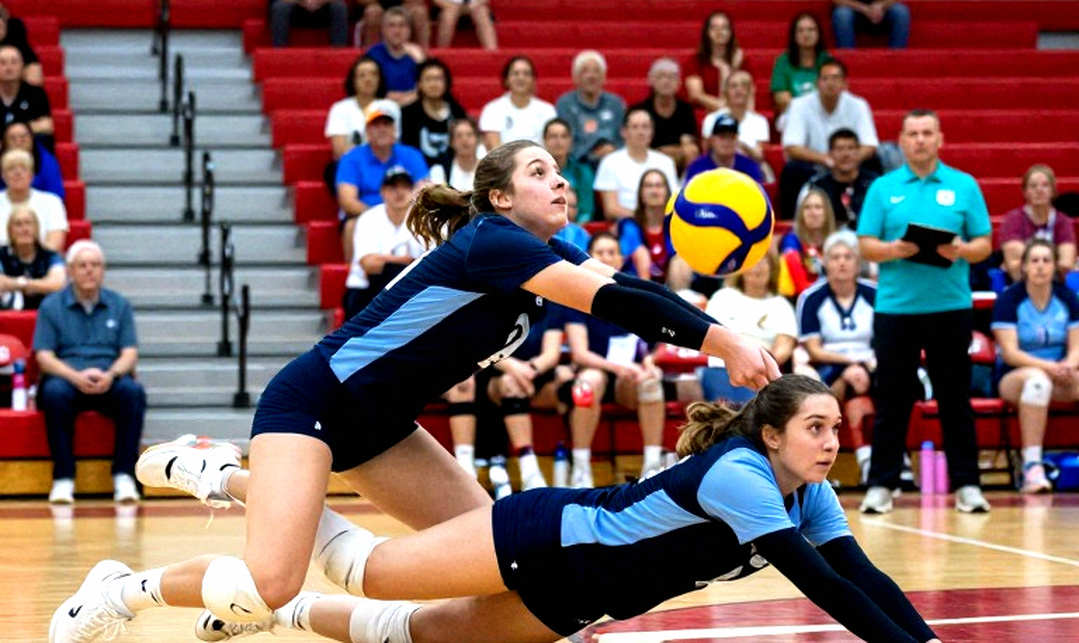
I do not have data on the bench depth of either team, so I cannot fully conclude on this aspect. But the trend is clear: a team that distributes risk is usually more sustainable than a team that concentrates on one individual.
There is one personnel detail I want you to notice: Suli Davis is a sophomore. This means SMU has a long runway ahead with her in the roster. A program can sustain competitiveness for years when it has a rising young core. This is the sign of a program built for the future, not just for the present.
On Pitt's side, head coach Dan Fisher is a program-builder of national caliber. How he reacted after the match is a notable management signal. He said his team "needed to experience those emotions." This is the language of a coach building resilience, not of a man panicking.
And Babcock herself, in her remarks, acknowledged that the team "had not yet met a high standard in matches." This is self-awareness about internal standards, and it shows a healthy accountability culture in the locker room. When stars question themselves instead of blaming circumstances, the risk of internal fracture drops significantly.
THE REMATCH: A CHESS GAME REPLAYED IMMEDIATELY
There is one scheduling detail that makes this match especially fascinating from a tactical standpoint: the two teams will meet again just days later, on Sunday, October 11, and the rematch will be broadcast on ESPN.
A home-and-home meeting within days turns this into a two-game tactical series, where both coaching staffs must adjust almost immediately. This is a rare form of "replayed chess game." Pitt will have to find ways to reduce Babcock's load and open up secondary attacking options. SMU will have to prepare for a different look from the opponent.
I once told you that a good sports writer must look beyond one half. Age 52 taught me that a hot take is not recklessness, but daring to look beyond one half. And in this case, looking beyond one half means looking at the Sunday rematch.
There is a fitness point to note. If Babcock truly had to execute a large volume of attacks in this loss, she may enter the rematch with accumulated fatigue. With only a few days' rest, physical recovery becomes an important factor. This is a risk the Pitt coaching staff needs to manage.
On SMU's side, the challenge is repeatability. They had an excellent match at the net, but can they reproduce it? The block trend of three consecutive matches with at least 12 blocks is a positive signal, but individual peaks like Newsome's .519 and Livings' .435 are single-match numbers and should not be expected to repeat automatically.
The fact that the rematch will be broadcast on ESPN also says something about the commercial value of this matchup. A collegiate women's volleyball match being placed on national television is a signal of public interest. This also means more pressure for both teams, especially Pitt, which will have to defend its honor at home after having lost.
CONTRARIAN VIEW: WHERE I COULD BE WRONG
Now comes the part I always reserve for honesty with myself. Because if I only presented arguments supporting my thesis, I would have become a propagandist, not a writer.
The first thing I must admit: this is a single match. A single match is not enough to conclude the nature of a team. Perhaps SMU simply had a night of brilliance, and Pitt simply had a night of decline. I asked myself this many times as I rewound the tape.
Second: I may be reading too much into Pitt's concentration. Perhaps Babcock scoring 25 points simply reflects that she is an excellent hitter having a good match, and the team relying on her is reasonable. A star scoring many points is not automatically a weakness.
Third, and perhaps most important: I do not have data on Pitt's overall efficiency in this match. If Pitt actually played well in other facets and only lost because SMU played brilliantly at decisive moments, then my story about a "structural flaw" may be an oversimplification.
This is why I always remind myself that the majority is never wrong, but it never writes history either. I am not afraid of being wrong. What I fear more is writing a piece nobody remembers, that sparks no debate at all. If you read this and think I was wrong, I welcome it. Because it is those debates that make this sport come alive.
And I must also admit one more thing: I am a Brazilian writing about American volleyball for Vietnamese readers. There are cultural nuances in American collegiate volleyball that I may misread. I always try to remember that whenever I make a bold conclusion. The person standing between two shores has the advantage of seeing things that both insiders and outsiders are blind to, but also the risk of misreading context.
PROGRESSIVE CONCLUSION: WHAT I WILL WATCH
I do not want to end this piece with a summary. I want to end with a look forward.
SMU's win over Pitt is one of the most interesting stories of this NCAA women's volleyball season. It shows that a program built on balance, depth, and tactical discipline can topple a team with a brighter star. It shows that an unbeaten streak, however long, can be broken when another team finds the right way to exploit it.
What I will watch in the Sunday rematch is how Pitt adjusts. Will they open up secondary attacking options to reduce Babcock's load? Will Dan Fisher change his blocking scheme to counter SMU's middle-blocking group? And on SMU's side, can they repeat their excellent net performance?
The answers to those questions will determine whether this win is a single moment or a true turning point. I lean toward the latter, because four top-10 wins and a 14-match ACC streak are the evidence of a rising team, not of a lucky one. But I am ready to be wrong.
Because in this sport, the only thing I am certain of is that the ball will always bounce in ways that force us to rethink. And that is exactly why I still write, still watch, still debate after all these years. When American collegiate women's volleyball produces matches like this, I find myself reminded of why I loved this sport from the start. Not because of the stars, but because of the systems. Not because of the unbeaten streaks, but because of the moments when they are broken by a better-organized team.
And you, dear Vietnamese reader, if you follow American collegiate women's volleyball, tell me what you think. If you do not yet follow it, start with this rematch. Because sometimes, the biggest tactical lessons come from the courts we least expect.