
2026 U.S. Open: 118 Events and the Operating Model Behind the Medal
**Câu trả lời cốt lõi**: Giải vô địch bóng bàn U.S. Open 2026 diễn ra từ ngày 16 đến 21 tháng 12 năm 2026 tại Mandalay Bay, Las Vegas, với 118 nội dung trong sáu ngày. Người chơi phải là thành viên USATT hạng Gold hoặc trọn đời còn hiệu lực đến ngày 21 tháng 12 năm 2026, và đăng ký trước ngày 1 tháng 12 năm 2026 vì một số nội dung có thể kín chỗ sớm. **Dữ kiện chính**: - Giải kéo dài sáu ngày, từ 16 đến 21 tháng 12 năm 2026, tại Mandalay Bay trên dải Las Vegas Strip. - 118 nội dung gồm đơn mở rộng, nhóm tuổi, trẻ, rating, para, hardbat, sandpaper và Parkinson. - Hạn chót đăng ký là ngày 1 tháng 12 năm 2026; giới hạn sức chứa có thể đóng nội dung phổ biến sớm. - Người chơi phải có thành viên USATT hạng Gold hoặc trọn đời, hiệu lực đến ngày 21 tháng 12 năm 2026. - Chung kết ngày 20 tháng 12 năm 2026; chỗ ngồi theo nguyên tắc đến trước phục vụ trước với Day Pass. **Nguồn**: Thông báo chính thức của USA Table Tennis (USATT), công bố năm 2026. | Cross-checked: VuaBong.vn **Hỏi đáp liên quan**: H: Hạn chót đăng ký là khi nào? Đ: Ngày 1 tháng 12 năm 2026, dù giới hạn sức chứa có thể đóng một số nội dung sớm hơn. H: Cần loại thành viên nào để thi đấu? Đ: Thành viên USATT hạng Gold hoặc trọn đời hiện hành, còn hiệu lực đến ngày 21 tháng 12 năm 2026. H: Khán giả vào xem chung kết cần gì? Đ: Một Day Pass ngày 20 tháng 12 hoặc thẻ phù hợp, với chỗ ngồi theo nguyên tắc đến trước phục vụ trước.
December 1, 2026. That is the registration deadline for the U.S. Open Table Tennis Championships, and according to the official notice from USA Table Tennis, some events may fill before that date. From December 16 to 21, 118 events will take place at Mandalay Bay on the Las Vegas Strip. These are the first numbers I cross-checked when reading the announcement, and they shape how I approach the whole event.
The striking detail is not the number 118. It is that not a single player is named. No world ranking, no seeding, no historical head-to-head records. A national championship that mentions no individual athlete is a strategic decision, not an editorial oversight. It signals that this event is designed to sell participation, not to sell a star.

Context: a national event, not a stop on the WTT circuit
Place the event in the right frame. The U.S. Open is not part of the ITTF or WTT world-ranking points system. Results here do not move global rankings. Its value lies in USATT's internal rating system and in its position on the U.S. domestic calendar, where it is described as one of the biggest weeks in American table tennis.
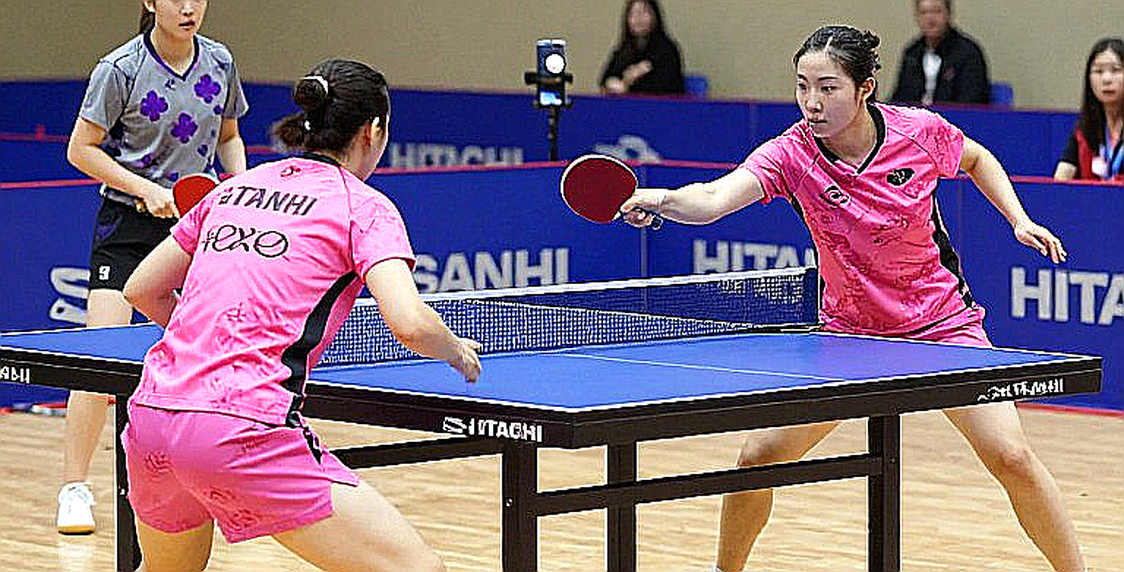
The event structure confirms this. The 118 events span open singles, age-group singles, junior categories, rating events, para competition, hardbat, sandpaper, Parkinson's categories, and Family Generational Doubles. Six days of play, with hall hours from 8 a.m. to 9 p.m. Organizers explicitly note that participants should not assume their competition is concentrated on a single day.
This taxonomy is categorical, not technical. It says nothing about playing style, tactics, or the competitive quality of any individual. It reveals the design philosophy of the tournament: multi-format, multi-audience, maximizing participation.
Core insight: hardbat, sandpaper, and the bimodal structure of American table tennis
The presence of hardbat and sandpaper in the event list is the most analytically meaningful signal in the entire announcement.
Hardbat is a pre-sponge-era style: pips-out hard rubber on both sides, no sponge layer, producing minimal spin and a flat, fast-driving game. Sandpaper is even more primitive, using a sandpaper racket surface designed for fun and beginner accessibility. Both stand in complete opposition to the modern inverted-rubber loop-drive system.
The presence of these two categories alongside open singles reveals a bimodal participant base: serious competitors and recreational players coexisting within a single tournament structure. This is not a signal of a sport in technical transition, but of a sport managing the diversity of its player base.
My experience covering national-level tournaments points to a pattern: when a federation places heritage and inclusion categories inside its flagship event, it is prioritizing member retention over elite concentration. That is not wrong. It simply means the event's value lies in participation breadth, not competitive depth.
The competitive implication is clear. A tournament featuring junior, age-group, para, Parkinson's, and family events reflects a wide participation pyramid. But it does not show junior-to-elite conversion efficiency. The presence of junior events proves a base exists, not that a talent pipeline exists.
Operating rules: the membership requirement is the real barrier
The governance section of the announcement is purely operational, yet it holds the most important signal for participants.
Players must be current USATT members at the Gold or Lifetime tier, and membership must be valid through December 21, 2026. A Player Credential is required for playing-hall entry. Spectators and non-credentialed attendees need a Day Pass or Full Tournament Pass. Finals admission is included with an appropriate credential or a December 20 Day Pass, and seating is first come, first served.
The Gold or Lifetime membership requirement, rather than a lower tier, is a membership-conversion lever embedded in the flagship event. Operationally, it is a binary test. There is no room for discretion. You are a member, or you cannot play.
This creates a distinctive risk surface. The highest risk is not injury, not the draw, not form. The highest risk is a player discovering the membership requirement too late, or missing the December 1 registration deadline by waiting. The combination of a registration deadline and capacity limits produces one clear imperative: act early.
Contrarian angle: the silence around stars is not a weakness, it is the business model
A conventional reading would treat the absence of names as a sign of a tournament lacking appeal. I think that reading is wrong.
A national federation runs its biggest event of the year on three revenue streams: membership, ticketing, and the local ecosystem. Choosing Mandalay Bay on the Las Vegas Strip is not coincidental. It couples competition with destination tourism, where accommodation, dining, and entertainment become part of the experience. Organizers even encourage early accommodation booking and mention things to explore nearby.
In that model, naming a star would dilute the message. The message is not come watch someone win. The message is come, play, stay. A 118-event, six-day tournament at a resort is a sports-tourism product more than a sports-media product.
Still, a clear distinction is needed. The Los Angeles 2028 Olympic context creates a strategic window. 2026 sits roughly two years before a home Olympics. A large national event in this window could carry foundation-building significance. But the announcement makes no Olympic-linkage claim. Any inference about the event's talent-development role sits outside the source, and I will not build conclusions on that foundation.
The same holds for the question of international competitiveness. World table tennis has a clear dominant tier, followed by a challenger group, then emerging regions. The U.S. Open sits in the domestic national tier of an association outside the leading group. The announcement provides no data on the gap to the leading group, and I will not manufacture that data.
Signals and points to track
What I will track in the next cycle is not results, but the fill rate of events before December 1. If many events fill early, that is evidence of demand exceeding supply in a specific segment. If USATT relaxes the Gold or Lifetime requirement, that is a signal of access pressure. And if future announcements add language explicitly linking to Los Angeles 2028, the event's strategic value rises a notch.
Six days, 118 events, one resort, and a binary membership barrier. This is a complete operating model, not a simple invitation. The question worth asking is not who will win. The question worth asking is whether this model can convert recreational players into paying members, and whether it can nurture a talent pipeline strong enough to leave a mark in the home-Olympic cycle.